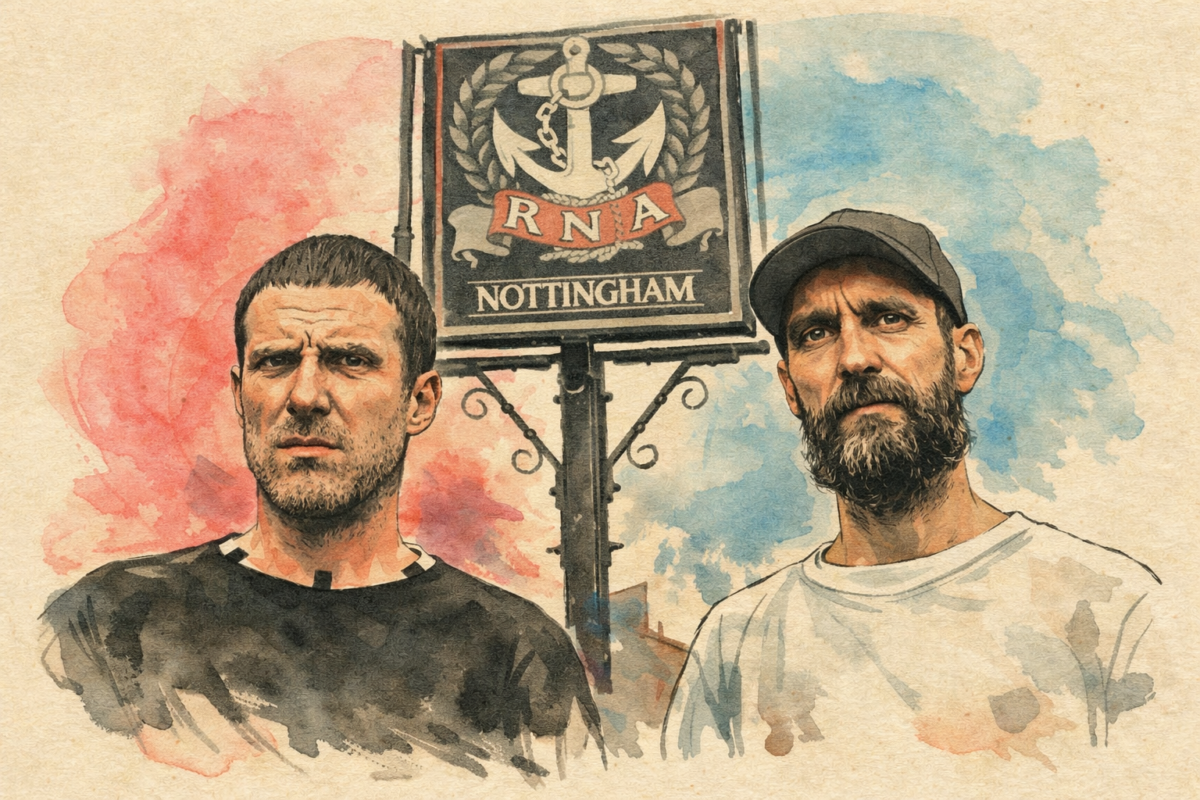
SLEAFORD MODS: AGIT-ELECTRO FROM THE BUS OF DOOM
Sleaford Mods Interview: Urban Britain Through Agit-Electro
There are bands that soundtrack a city. And then there are bands that document it. When Sleaford Mods first emerged from Nottingham’s overlooked edges, they weren’t offering escapism. They were offering observation, forensic, furious and frequently hilarious. The office politics, the council corridors, the ten-mile bus commute. The small humiliations. The economic hangover. The face of Britain reflected in the top deck window. Jason Williamson answers the phone from what he calls “the bus of doom.” It takes him to work and back each day. Not a metaphor. A literal route across a Midlands landscape that feeds directly into the duo’s stripped-back drum machines and serrated lyrics.This is not abstract protest music. It is hyperlocal reportage.
Place as Material
Nottingham isn’t just backdrop in Sleaford Mods’ catalogue, it is infrastructure. Williamson’s Lincolnshire roots, the East Midlands cadence, the council office environment, the bus routes, the pubs, the worn-out estates. Sense of place runs through everything.“Most of the stuff in the songs, apart from the philosophical bits, is centred around people and places I know,” he says. “Jobs I’ve been in. Personal failures. All chucked in one big melting pot.”
Watch the video for Tied Up In Nottz,filmed from the top deck of a bus and you see the thesis in motion. Faces pressed into windows. Grey estates sliding past. A country uncertain about its own story.This is creative travel in reverse. Instead of romanticising cities, Sleaford Mods expose their infrastructure ,the bits usually hidden behind tourism boards and glossy regeneration campaigns. For the culturally curious traveller, that honesty is more revealing than any skyline shot.
Britain After the Boom
Williamson talks about Thatcher. About New Labour. About consumerism and despondency. About friction in the early 1980s versus the quieter fatigue of the 2010s.“People were more responsive then,” he says. “Now there’s a lot of despondency.”
His references to mod culture and rave communities aren’t nostalgic gestures. They are attempts to locate where counter-culture might re-emerge — if it ever does.“I still class myself as a mod,” he says, carefully. “But not in the stereotypical sense. I like a good haircut. A good pair of shoes. I’m not getting bunged in with all that other shit.” It’s not revivalism. It’s evolution.
Sound Without Ornament
Musically, Sleaford Mods are brutally efficient. Andrew Fearn’s minimal drum machine loops and basslines create skeletal frameworks for Williamson’s delivery — half rant, half poetry, all momentum. It’s home-grown, almost anti-production. A deliberate stripping away.“No not really, it’s shit innit,” Williamson says of the ‘punk hop’ tag. “If anything we do rap.”
They’ve been compared, commodified, labelled and platformed by the same cultural machinery they critique. Williamson is pragmatic about it. “That’s just the way the industry works. You’ve just got to be truthful to what you do. You’ll know you’re sticking to your guns when they turn their backs.” It’s a rare admission: coolness is incidental. Integrity is the metric.
Touring the Friction
Germany. Switzerland. London. Brighton. Cardiff. Sheffield. Sleaford Mods carry their commentary across borders. British austerity exported into European clubs.For the creative traveller, this is a reminder that cities are not just destinations; they are ecosystems of labour, identity and aspiration. Touring circuits become informal maps of contemporary Europe. The same frustrations echo in different languages. And yet Williamson still rides the bus home from his council job between shows.It grounds the mythology.
At its best, cultural reportage should do more than profile a band. It should illuminate the terrain that produced them. Sleaford Mods offer something rare in British music: unfiltered geography. Nottingham is not aesthetic backdrop; it is engine room. The council office, the bus route, the overheard argument, the slumped commuter — these are not metaphors. They are source code. In an era where cities are increasingly packaged for consumption, Williamson’s dispatches feel like field recordings. A reminder that place is lived before it is marketed. That accents carry architecture. That politics is embedded in routine. The number 36 may not promise glamour.But from the top deck, you can still see the shape of a country.