Abi Huxtable on Retouching, Painting and Letting AI Show Its Seams – An interview with Matt Price for Fused
Abi Huxtable’s route into painting was not a clean break from her earlier career, but a prolonged negotiation with it. Trained in photography at a moment when computers were still viewed with suspicion, she went on to build a long and highly specialised career in fashion image retouching – precise, largely invisible work where the aim is not transformation but restraint. Alongside this, however, ran a persistent desire to make work that did not serve someone else’s image. Painting became a way of reclaiming authorship, even as questions of photography, technology and image culture refused to disappear.
In this conversation, Huxtable speaks to Fused about studying photography in Wales in the late 1990s, two decades of fashion retouching, and her gradual move towards painting via an MA at the Royal College of Art. Central to the discussion is her recent use of generative AI – not as a tool for perfection, but as a system whose biases, failures and hallucinations can be exposed, questioned and repainted. Rather than smoothing over the seams, Huxtable allows them to remain visible, using them to think through consumption, technology and the uncertain futures we are already inhabiting.
Fused: Where are you from? Where did you grow up?
Abi Huxtable: There isn’t really one answer. I was born in Surrey, and lived in Lincolnshire for a while, but grew up mainly in Hampshire and Dorset for the longest period. I moved around quite a bit.
Fused: Where in Hampshire?
Abi: On the edge of the New Forest. It was very picturesque. I was there for about ten years, and then I went to study at the University of Wales College, Newport to join the Documentary Photography course.
Fused: What year was this?
Abi: 1997. It was my top choice and quite a prestigious course at the time. I was lucky to get on, but then I quickly realised that I didn’t actually like it.
Fused: Why was that?
Abi: It was very focused on process and authenticity – the idea that you had to shoot endless rolls of film, follow a subject rigorously, and commit to a particular documentary ethic. I wasn’t interested in that. I was much more drawn to experimentation and using computers, which in the first year was pretty much forbidden.
Fused: So you switched courses?
Abi: Yes, I moved to the Photographic Art degree, which was a new course at the time. It suited me better, but it still wasn’t quite right. I didn’t feel there was a clear path – there wasn’t a sense of ‘this is what you become if you do this course’.
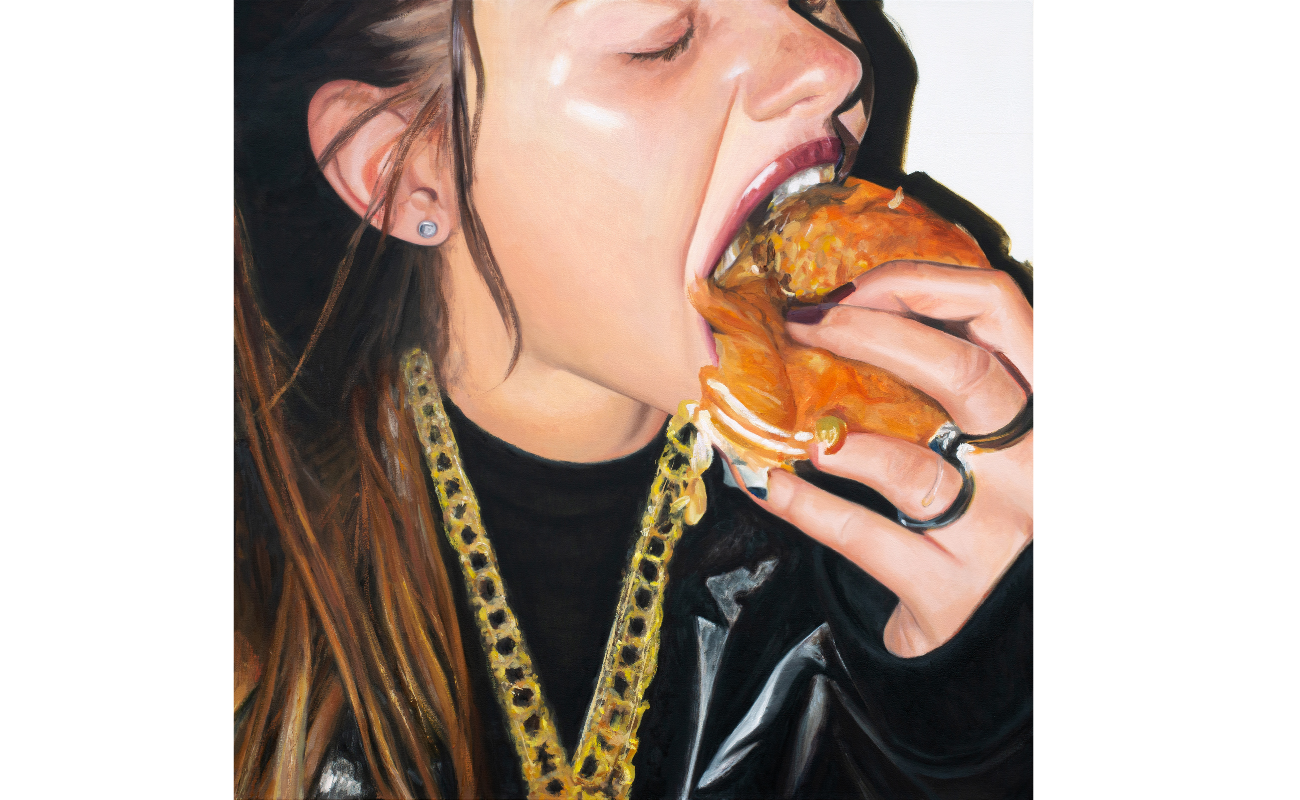
Abi Huxtable, A gen z woman messily eating a hamburger. She is wearing a chunky gold necklace and a shiny black puffer jacket on a white background, 2023, oil on canvas, 76.2 x 76.2 cm
From Documentary Photography to Fashion Retouching
Fused: How did you move into more commercial work?
Abi: A lot of my interest was in digital manipulation. I was looking at artists like Nancy Burson, who was making composite portraits long before AI – morphing faces to explore notions of age, race, beauty and power. Nowadays it would be relatively straightforward to make this kind of work, but studying then the work she’d made in the late seventies and into the eighties, it felt quite radical. That fascination led me into retouching, which became the foundation of my working life.
Fused: Retouching has remained central to your practice?
Abi: Yes, very much so.
Fused: How did that begin after university?
Abi: After leaving Wales, I didn’t really know what to do. I wanted a change, so I took a year out and worked in South Korea teaching English. Then I travelled for four months around Asia to Cambodia, Vietnam, Laos, Thailand. When I came back, I started applying for jobs with a focus on digital work, and I got a role at an image library. From there, retouching became the constant thread. I’ve done other roles along the way – I worked in Amsterdam for a couple of years at advertising agencies as an art buyer, which was more on the production side – but most of the time I’ve been behind the scenes, retouching for photographers or studios.
Fused: What kind of studios?
Abi: It’s very niche – fashion photography. People like Tyrone Lebon or Alasdair McLellan. For almost the last twenty years I’ve been working within that world.
Fused: How would you describe what retouching actually involves?
Abi: It’s often misunderstood. People assume it’s about making bodies thinner or faces more ‘perfect’, and while that does exist, the photographers and studios I work with generally want to avoid that. It’s more about keeping things natural and not drifting into problematic body politics. A lot of it is technical problem-solving – changing details, removing distractions, swapping garments. Sometimes it’s very intricate: once I had to remove a marquee behind a shower of water, which meant essentially painting in water droplets. Other times it’s repetitive; clone stamping, fixing red hands. It’s full of small, invisible decisions.
Generative AI as Mirror, Not Machine
Fused: How has AI affected that industry?
Abi: It’s hard for me to say definitively because I’ve already had to step back from retouching to some degree to spend more time on my painting practice. Balancing the two is difficult. But I’ve noticed that colleagues are working less. AI has absorbed many of the lower-end jobs, and there’s simply less work overall. That said, it’s not only AI. Advertising budgets have shrunk globally. Friends who work in styling and make-up are also experiencing a downturn. There’s a general tightening across the industry.
Fused: When did painting start to feel essential rather than secondary?
Abi: Around 2012. I realised I wanted to do something more creatively autonomous. Retouching felt like I was refining other people’s ideas rather than contributing my own. I wasn’t satisfied. I began doing short courses and working at home. Then, in 2014, I did the Slade Summer School, which completely changed my outlook. Until then I’d treated art as a hobby. After that, I knew I had to take it seriously. I went on to do an HNC at Kensington and Chelsea College. During that time I applied to the RCA and was surprised to be accepted.
Fused: How did you experience the RCA?
Abi: I don’t think I was fully ready. Many people arrive with a highly developed sense of who they are as artists. The RCA is more about refinement than exploration, and I was still searching. That said, the first year was incredible – lots of strong conversations, critical thinking and friendships. In my second year, though, I worked mostly from home in Essex because the commute was so long. That distance made it harder to stay connected.
Fused: But you still left wanting to be a painter.
Abi: Yes.
Fused: How did you manage that alongside earning a living?
Abi: After graduating in 2017, I had to return to retouching more fully, partly because I hadn’t worked much during my final year. I also really enjoyed writing the dissertation, and I think it’s a shame that aspect has been reduced – it gives you space to think critically about your work in a way that’s quite rare. Since then, it’s been a constant juggling act; painting alongside paid work, and occasionally exploring other ways of supporting myself. Time is always the challenge.
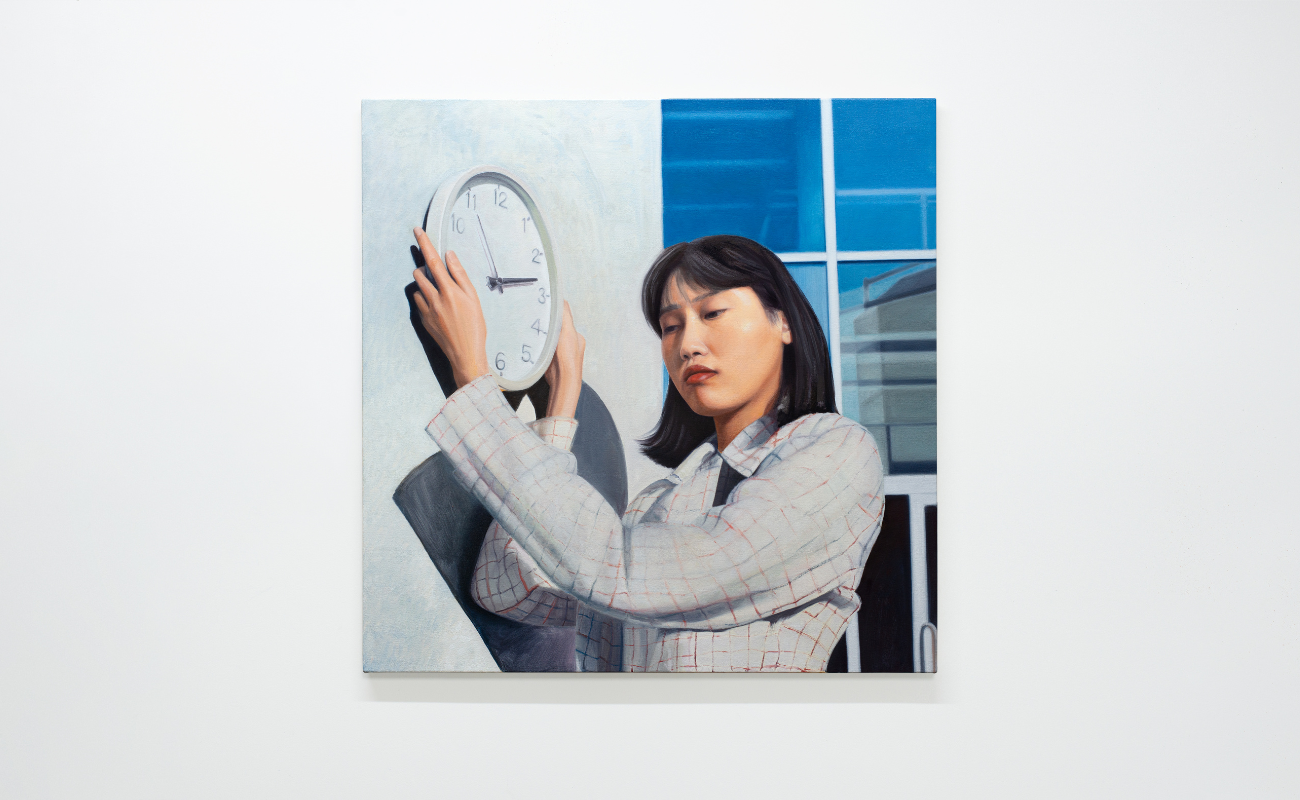
Abi Huxtable, A female gen Z digital nomad wearing millennial fashion, changing the time on a 3D printed clock, 2024, oil on canvas, 76.2 x 76.2 cm
Fused: What kind of work were you making immediately after the RCA?
Abi: My practice has changed a great deal. For my final show I made an installation rather than a painting-led presentation. I did show abstract paintings, but the main piece was sculptural: a fridge containing a shishi-odoshi fountain, with a circular porthole window allowing you to look inside. The idea came to me while meditating in the kitchen. My work often circles around time, space and cycles. There was something about the sound inside the fridge, the circulation of water and the overlap of different temporal experiences.
Fused: At that point, were you deliberately distancing yourself from photography?
Abi: Yes, completely. During the MA I struggled with figurative painting because of my deep connection to photographic images. I’ve taken photographs since I was very young, and that history is hard to escape. At that time, photography felt tied to nostalgia, to the past, to something fixed. It felt like a full stop. I experienced it as static and limiting, and I wanted to remove myself from it entirely.
Fused: That led you towards abstraction?
Abi: After the RCA I focused on abstract painting. I explored it for a long time, hoping it would eventually click, but something still felt unresolved. There’s a painting from around 2018 that captures that frustration. It was based on an editorial image by Juergen Teller of Harmony Korine in a diner. I cropped it to focus on the act of consumption, but I never finished it. In retrospect, I’m glad – it’s more interesting unfinished. I didn’t know how to move forward with it; it felt shallow, like there was nowhere to go.
Fused: And AI changed that impasse?
Abi: In 2023, yes. I started hearing more about generative AI and decided to experiment. To test it, I began prompting images of people eating burgers. Those images became the basis for the burger paintings. It wasn’t about returning to fashion imagery consciously. That unfinished Juergen Teller-based painting had been the point where I got stuck with figuration. AI felt like a key, something that allowed me to ask new questions about how to proceed.
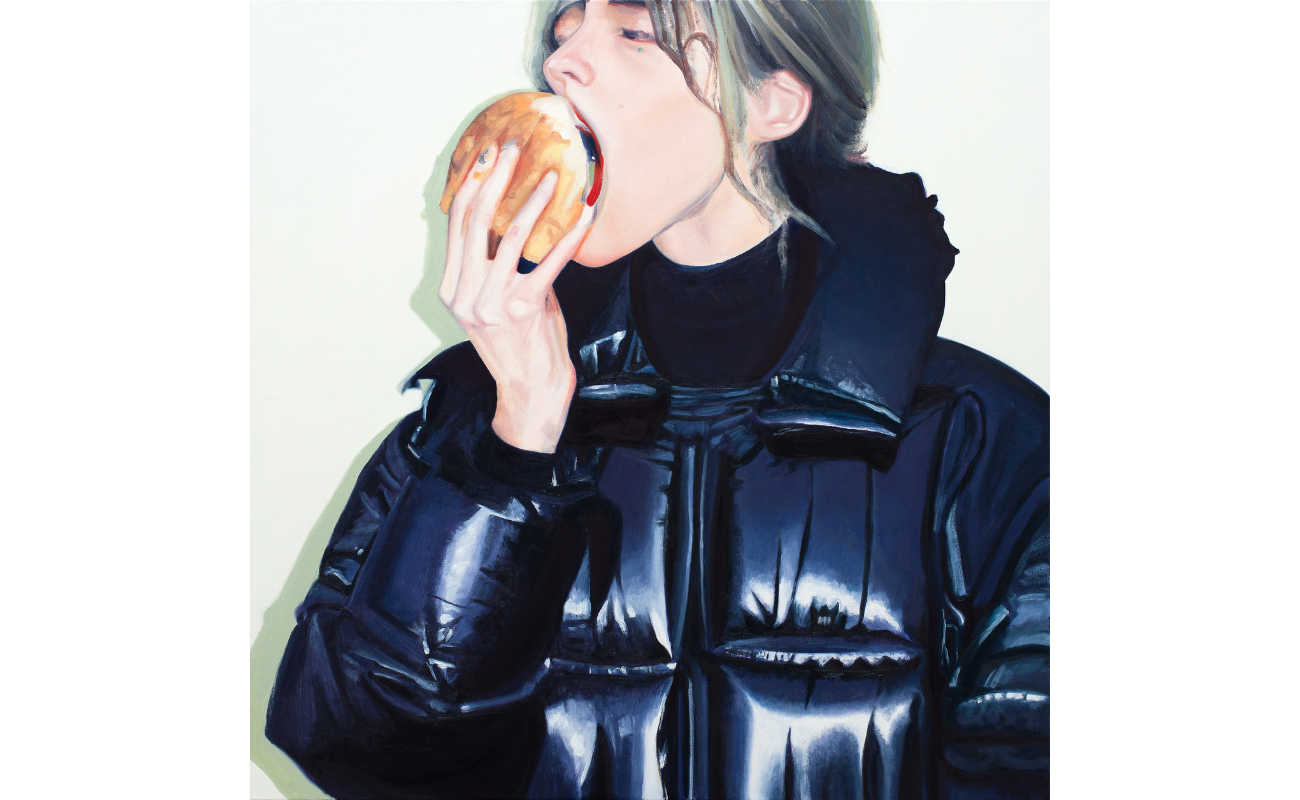
Abi Huxtable, A woman eating a hamburger, wearing a black puffer jacket, 2023, oil on canvas, 76.2 x 76.2 cm
Fused: How do you begin a work using AI?
Abi: The starting point is usually a personal observation – something I’ve overheard or noticed. For instance, in winter I felt like everyone was wearing black puffer jackets, so they made their way into the paintings alongside the burgers. But I don’t purposefully encode emotion directly into the prompt. I use neutral, descriptive language rather than emotive terms. I want to see what the system reflects back; almost like a magic 8 ball, you get something unexpected, something magical. What fascinates me is that AI is a projection of what we’ve already produced. It’s an insight into society. I feel the paintings act as a source of knowledge production. It reflects our collective past – our data, our habits, our biases. It doesn’t have subjectivity; it recombines what already exists.
Fused: Bias plays a role in that reflection.
Abi: Very much so. Gender, race, visual conventions – it all comes through. You also see what programmers assume we want to see. Even the hedonic value of the people we see isn’t neutral, and I try to navigate around that. For example, using ‘Gen Z’ in prompts gives me a more naturalistic figure than ‘young woman’ or ‘female’. There’s an ideological dimension to language choices. I’m manipulating the system, but I also make that process transparent by using the prompt as the title.
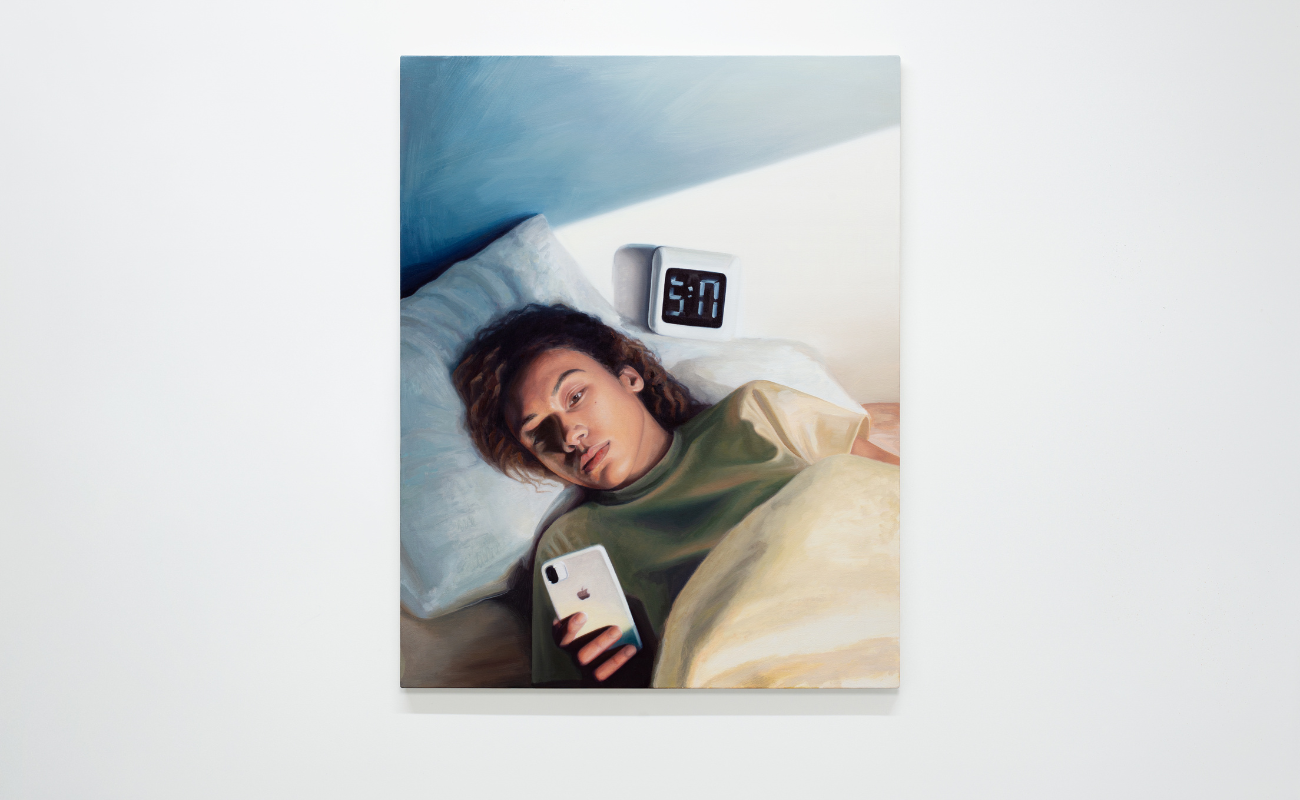
Abi Huxtable, Screen Time (Gen Z person waking up in bed, looking at their iPhone. Time is 5:59 on Groundhog Day alarm clock [Panasonic-RC 7025]), 2025, oil on canvas, 96.5 x 76.2 cm
Abi: Absolutely. I don’t want to push the system until it produces something ‘correct’. I’m more interested in the gaps – what it can’t do, how it hallucinates details, how it approximates text or objects. In one painting I wanted to include a specific model of alarm clock – the one from the movie Groundhog Day, showing 5:59 a.m. Even using the model number it couldn’t replicate it. Those failures are revealing. They show how the system fills in missing knowledge, and that’s far more interesting to me. In a strange way it’s all circling back to my interest in documentary photography, as I want the paintings to serve, in part, as a record of this time we’re in and where the technology is at.
Fused: There’s also a sense of anticipation in watching images generate.
Abi: Yes. Especially early on, when you could see the image slowly resolving. There’s something performative about it – a reveal. I’m also interested in metaphysics and tarot, and there’s a shared sense of uncertainty and possibility there. You wait to see what emerges.
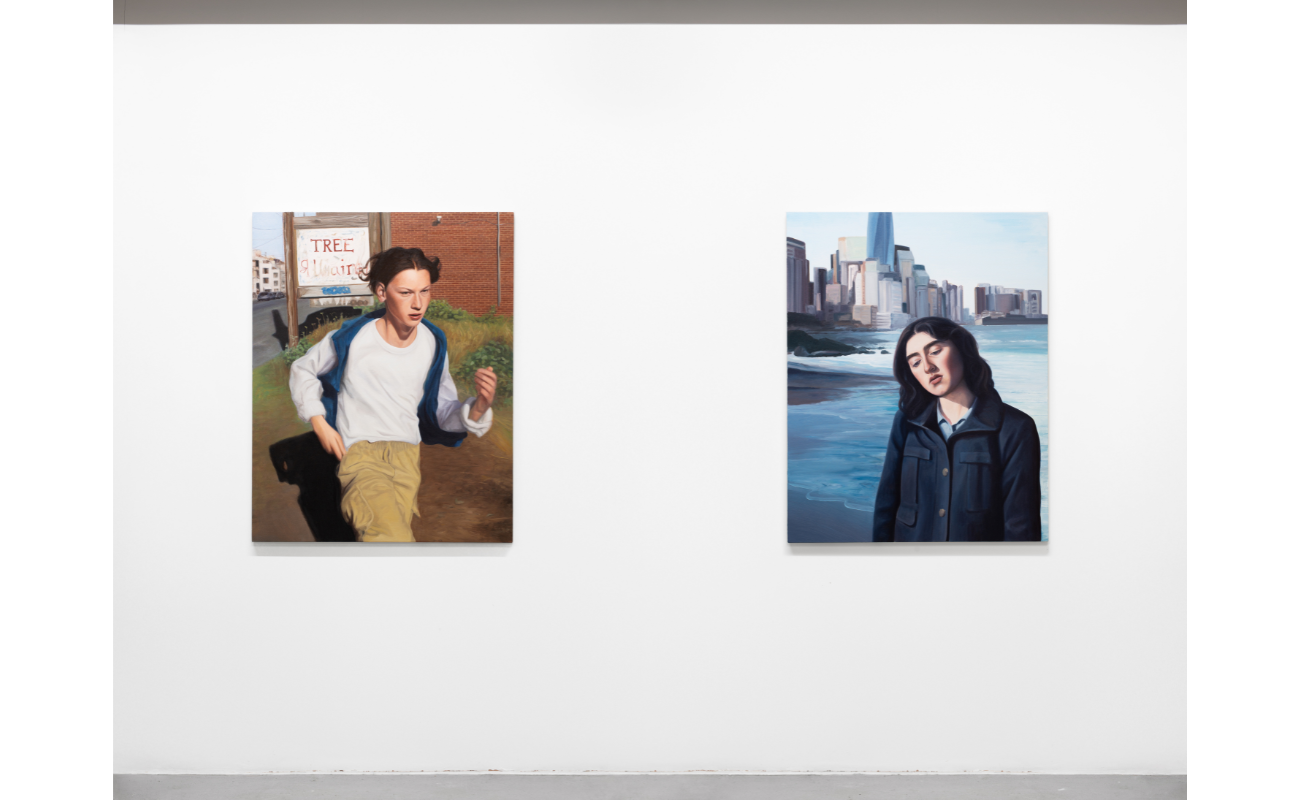
Abi Huxtable, Left: Rerun, 2026, oil on canvas, 96.5 x 76.2 cm; Right: A gen Z female working on a laptop in a cafe (remove background, Generative Fill, no prompt), 2025, oil on canvas, 96.5 x 76.2 cm
Fused: Can you talk about the Rerun work?
Abi: That came from a mistake. I typed ‘rerun’ instead of clicking the button, and the system interpreted it literally, producing a figure running. It misunderstood completely – but I liked that misunderstanding.
Fused: Linguistically, that’s fascinating.
Abi: Exactly. ‘Rerun’ doesn’t mean ‘run’, but that’s what it inferred. It shows how unstable interpretation can be.
Fused: There’s an earlier painting – an interior scene with a woman on a sofa – that marks another shift.
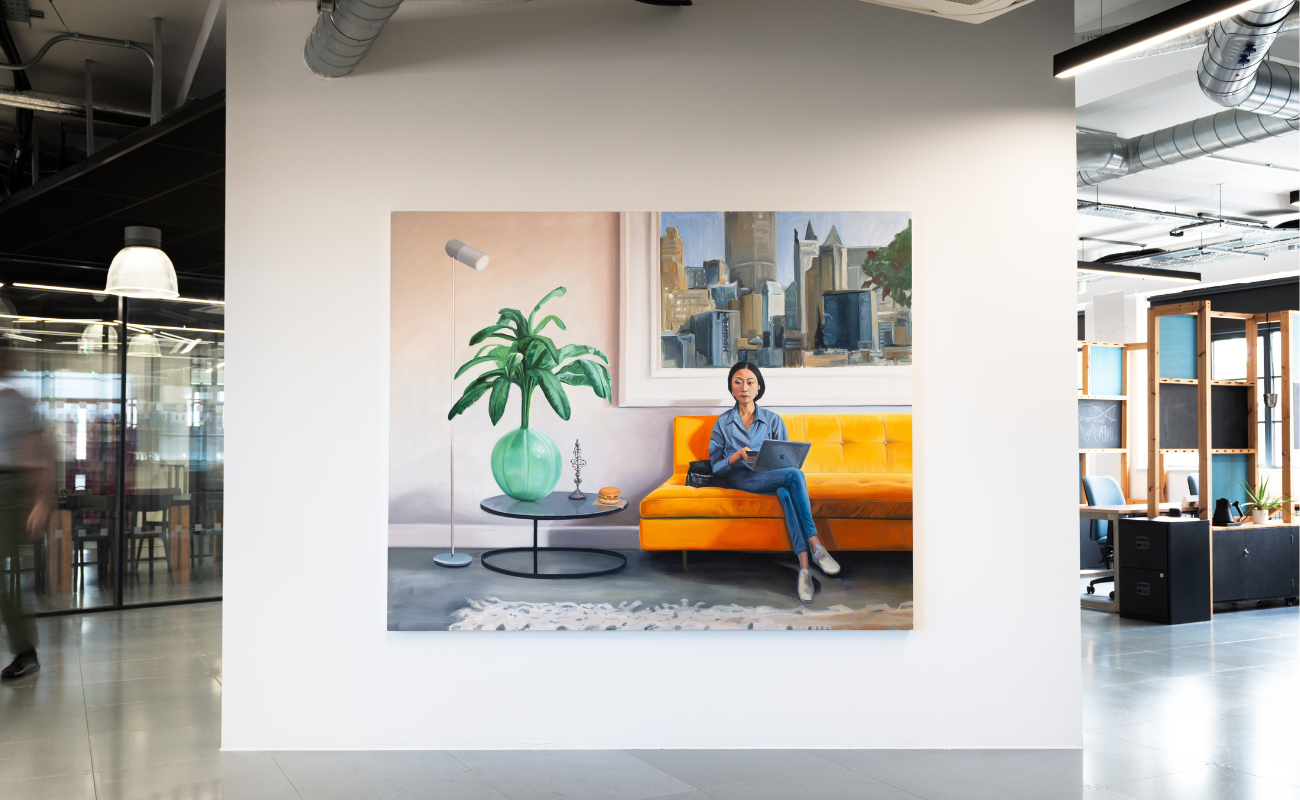
Abi: That developed through a Web3 residency with a decentralised autonomous organisation. People often associate Web3 with crypto scams, but there’s also a lot of good being done in these spaces – experiments with collective, non-hierarchical ways of working. I was working with FAB DAO during the residency and their focus is art for public good. Talking to them, I became interested in the physical spaces associated with digital nomadism – Airbnbs, temporary interiors, anonymous environments. They’re often neutral to the point of emptiness. That led to ideas about comfort objects – things you might carry with you. I used an inflatable plant in a prompt as a symbol of portability and familiarity. In the painting, there’s also a work within the work asking the AI to imagine utopia.
Fused: That connects to questions of replication and memory.
Abi: Yes. I was thinking about whether a perfectly replicated object – 3D printed, identical in sound and texture – could hold the same emotional charge as the original. Would it satisfy longing? Would it feel authentic?
Gen Z, Digital Nomads and Image Culture
Fused: You return frequently to Gen Z figures. Why that generation?
Abi: It feels natural. I still feel that age internally, and I’ve spent so long looking at people of that generation through my work. There’s also a conceptual reason: this is the first generation to come of age alongside this technology. That transition into adulthood is culturally significant.
Fused: You were recently included in Don’t Look Back, a major group exhibition at Unit in London looking at nineties and noughties aesthetics in today’s art, curated by Beth Greenacre and Sigrid Kirk. How did that come about?
Abi: Completely out of the blue. Beth contacted me through my website and invited me to be part of the show. She hadn’t seen my work in person, just the images. It felt surreal at first.
Fused: And seeing the work there?
Abi: I loved how it was curated, especially the top floor. The rhythm, the colour, the way the works related to each other – it felt very considered. It was a significant opportunity, and I’m grateful for it. As an artist, it’s hard to get visibility, and moments like that really matter.
This interview, conducted in Abi Huxtable’s studio in East London in January 2026, has been transcribed using Adobe Podcast and edited by ChatGPT, with a human proofreader.
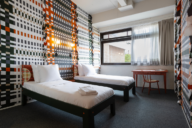
Top Image: Abi Huxtable, 3/4 view of Taiwanese, gen z, digital nomad, female, sitting on a modern sofa. (Inflatable houseplant), (Taiwanese ornament), (generic ornament), (hamburger), (what would utopia look like?), 2024, oil on canvas, 160 x 200 cm. Installation view, Creative Works, London
All images © and courtesy of Abi Huxtable