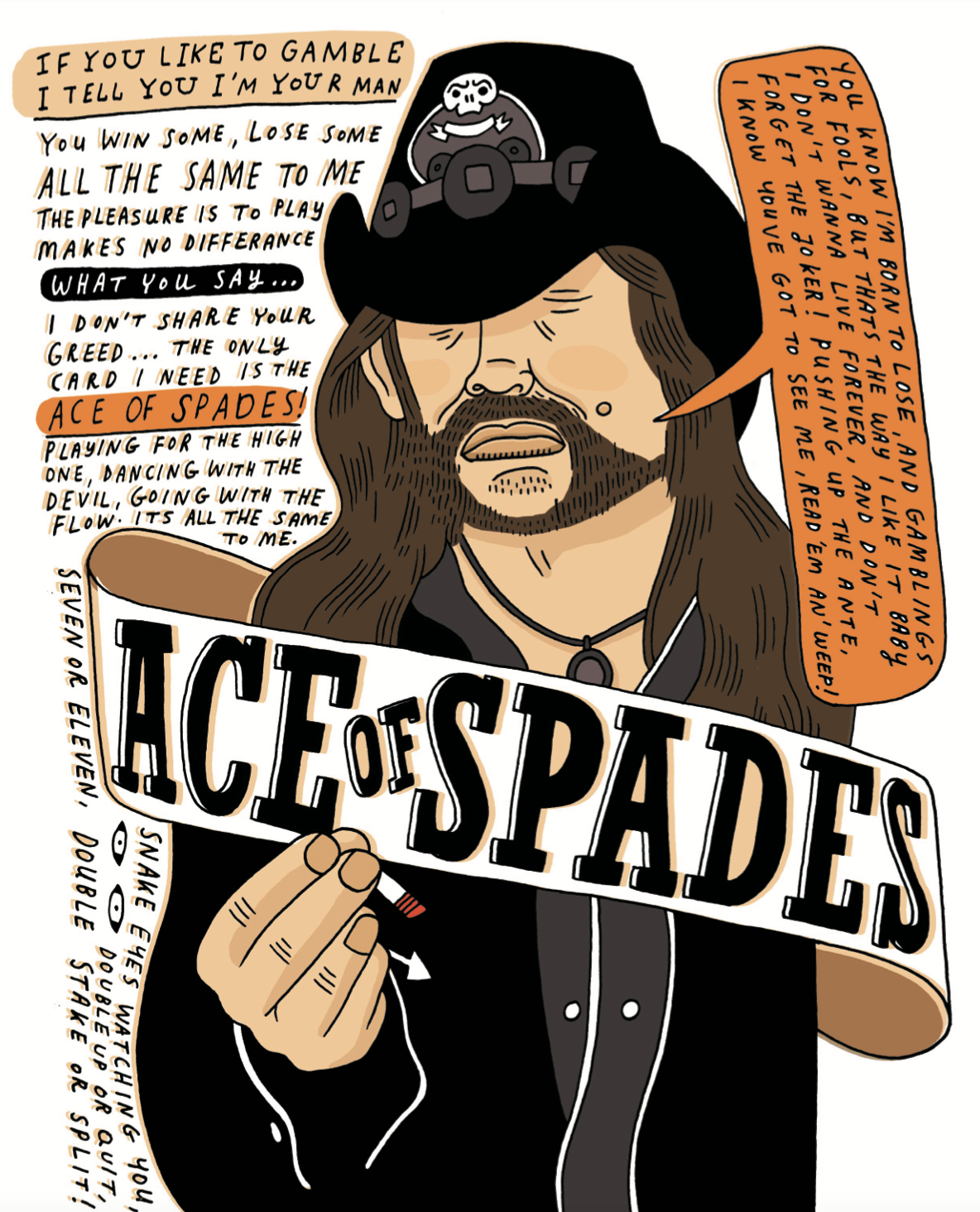
LEMMY KILMISTER: MOTÖRHEAD, MORTALITY AND THE MEANING OF ROCK
LEMMY ON MOTÖRHEAD, FAME AND ROCK ’N’ ROLL SURVIVAL
There are rock stars, and then there was Lemmy. Not because he drank more ,though he did. Not because he was louder, though he certainly was. But because he understood something fundamental about longevity in popular music: consistency is more radical than reinvention.
By the time Fused sat down with Lemmy Kilmister, Motörhead had already survived punk, hair metal, grunge and the digital apocalypse. They had outlived trends, fashions and most of their peers. While other frontmen softened their edges or retreated into heritage tours, Lemmy remained exactly what he had always been, a man permanently on duty for his band.
“Even if I stopped playing tomorrow I’d still be Lemmy from Motörhead,” he said. “Like McCartney is still Paul from the Beatles. You never shake that.”
There was no irony in it. No complaint. Fame, for him, wasn’t a burden — it was the job. And he took the job seriously.
Motörhead: Thirty Years Loud
Motörhead had, at that point, been “the dirtiest, meanest and loudest band in the land” for over three decades. When asked how he celebrated turning 60, Lemmy’s instinct was not extravagance, but avoidance. “I did it in Vegas, just stayed away from everybody, in case they had any surprises ready for me. Yeah, this is as good a way to spend your birthday as any. The next one I got to look forward to is 70, man, how is that for a big step?” Milestones were acknowledged, not romanticised.
Were there still goals left? “Yeah, I haven’t fucked Halle Berry yet for a start. There are always goals that you haven’t achieved. I’d like to have a hit in America before we go. I’d like to have another hit here too. Thank God for Germany, we still have hits there. They really stood next to us all the time, they were really loyal.” Germany, he noted, had an ability to embrace both old and new material simultaneously, a loyalty he clearly valued. In Lemmy’s world, markets weren’t statistics; they were territories earned over time.
On Health, Fame and Permanence
For a man synonymous with excess, he was remarkably unconcerned with self-preservation. “Why should I take care of myself? It’s all still working. I just had a medical in Berlin, they said I had the liver of a newborn baby and my lungs are fine. It’s incredible. My heart is fine. Figure it out.” Was it easy being Lemmy 24/7? “Yeah, I’ve never been anybody else. I can deal with it. A lot of people can’t deal with being famous. I like being famous, I’m used to it now.” He had little patience for performers who claimed to crave privacy. “You gave up being a private person when you ran on stage the first time. Well, quit music, motherfucker.” For Lemmy, identity was not a costume you removed after the encore. It was structural.
On Music: Old, New and Unforgivable
He kept an ear open to new bands, Crucified Barbara, Clutch, Meldrum, but he was unapologetic about his distaste for certain trends. “I hate Hip-Hop. I hate it. It’s the worst music black people have ever played. I loved black music. All the way through my life until the last ten years.” Yet even in criticism, there was an acceptance of plurality. “There’s room for everything. Any music can be played. There’s gotta be all kinds of music for everybody to listen to.” It was less a contradiction than an expression of absolutism. He didn’t want persuasion; he wanted autonomy.
Hawkwind, Sid Vicious and No Regrets
Was there lingering anger over being sacked from Hawkwind? “No. I don’t have revenge in my heart. It takes too long, and it makes you twisted and bitter. I don’t wanna be twisted and bitter.” On teaching Sid Vicious bass: “It was all uphill and he still couldn’t play bass when he died. I’m not sure if Sid was ever on the record. I think it was Steve who played bass.” Delivered without malice. Just fact.
The Curse of “Ace of Spades”
“It’s a curse and a blessing,” he admitted. “It’s a good song and you get tired of playing it, but it’s still a good song. We got lucky. We could have got famous for a turkey.” Luck, in his vocabulary, meant durability.
On Collecting and Obsession
His well-documented collection of Third Reich memorabilia was discussed with historical detachment rather than provocation. The artefacts were objects of fascination, not ideology.“Probably a Luftwaffe sword with a Damascus blade,” he said of his greatest treasure. There was always an edge to Lemmy’s interests, but never apology.
Touring as Cartography
For all the mythology, the Jack Daniel’s, the artefacts, the volume, Lemmy’s life was fundamentally about movement. Motörhead was not a studio vanity project. It was a touring machine. Berlin one week, Vegas the next, London, Scandinavia, America, repeat. He measured success in road miles and fair ticket prices. “You have to watch everything,” he said of touring economics. “E-V-E-R-Y-T-H-I-N-G.”
Heavy rock, in his hands, became a form of endurance culture. Cities blurred into each other, but the ritual remained constant. Soundcheck. Stage. Volume. Exit. Repeat. Geography wasn’t scenery; it was circuitry. Each venue another voltage point in a decades-long system of noise and loyalty. Germany stood firm. America still owed him. Britain ebbed and flowed.
Rock ’n’ roll as mapmaking.
In an era when music is streamed without context and scenes exist largely online, Lemmy belonged to a different order, one where bands earned territory physically. Where identity was inseparable from stage time. Where reputation was built city by city, not algorithm by algorithm. He never wanted escape. Why would he? The name had become architecture. Motörhead didn’t chase relevance. They occupied space, night after night, until relevance had no choice but to follow. Dust off the vinyl if you must. Pour the Jack Daniel’s if you insist.