Between Realism and Abstraction: The Art of Louise Howard
LOUISE HOWARD: PAINTING THE SPACE BETWEEN REALISM AND EMOTION
An Interview with the London Artist Redefining Contemporary Portraiture
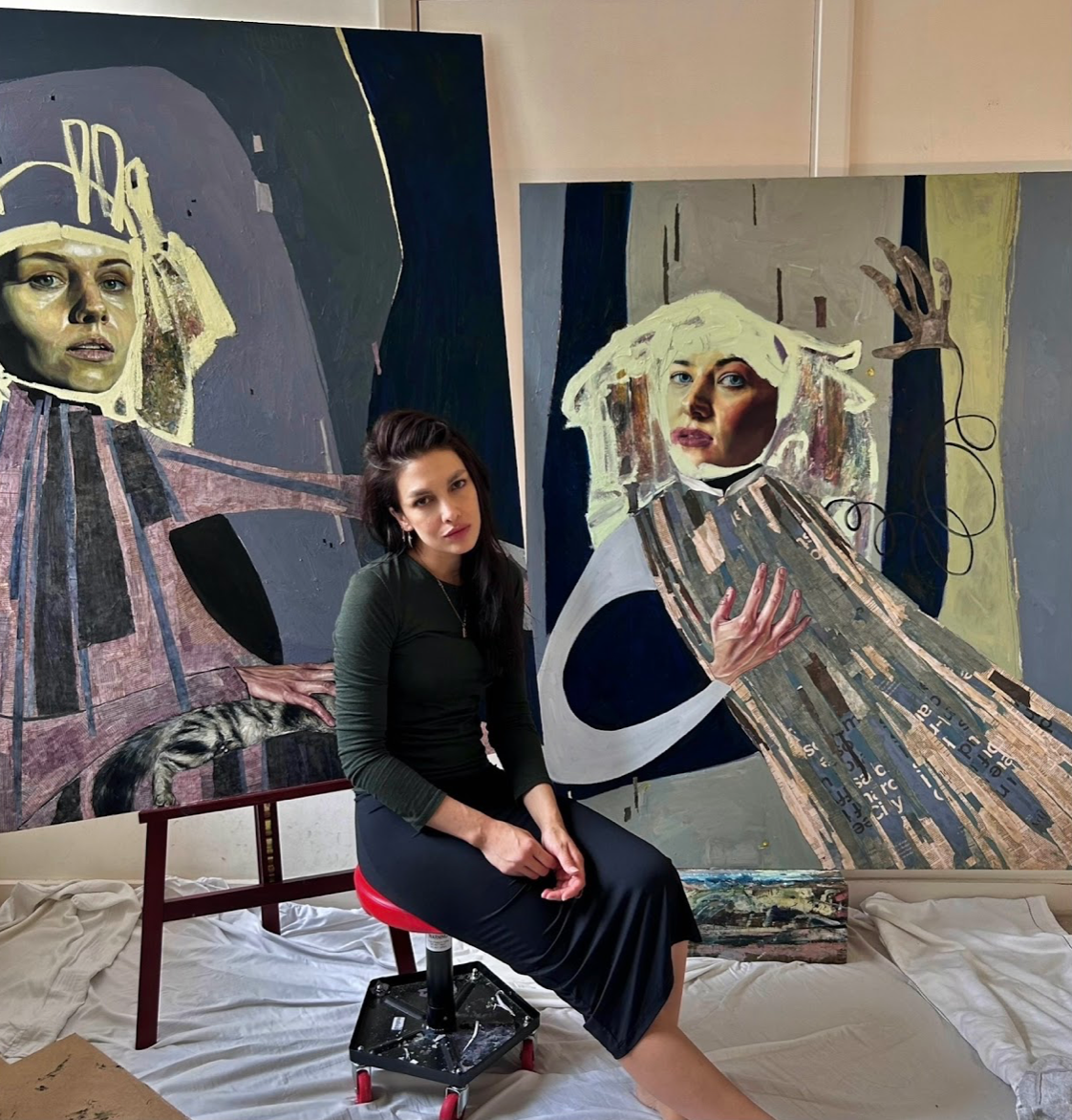
In a crowded art world increasingly hungry for spectacle and instant gratification, Louise Howard’s work stands apart. The London-based artist is known for her quietly powerful portraits — often of women — that tread a delicate line between realism and abstraction. Her canvases are neither wholly figurative nor entirely abstract; instead, they speak in a visual language that feels emotionally familiar, yet hard to pin down.
Over the past decade, Howard has built an international reputation, exhibiting in the UK, US and Australia. Her latest body of work, In Catfood and Wine, created in the wake of personal upheaval during the COVID-19 pandemic, marks a deeply personal moment in her career — vulnerable, resolute, and unmistakably hers.
We sat down with Howard to explore the instincts behind her process, her resistance to overt narratives, and the emotional weight carried by the faces she paints.
LOUISE HOWARD: PAINTING THE SPACE BETWEEN REALISM AND EMOTION
A Style Born of Evolution
Howard’s signature aesthetic — a fusion of refined realism and loose abstraction — didn’t appear overnight. “I’ve always painted in a fine art style,” she explains, “but around 2017, I wanted to push my work in a more contemporary direction. I wasn’t that familiar with abstract painting, but once I began exploring it, it quickly became essential to my style.”
While realism remains the foundation of her practice, abstraction offers a welcome counterbalance. “It gives me a moment of levity in my pieces — a kind of breathing space,” she says.
Faces as Emotional Landscapes
Howard’s work is driven by emotional resonance, often communicated through faces that radiate a quiet gravity. “I’m drawn to expressions that seem to hold something curious — strength, solemnity, maybe a bit of attitude,” she says. “They’re all semi-autobiographical in some way. Every painting holds elements of my personality, even if they’re not directly self-portraits.”
It’s no surprise, then, that she focuses predominantly on the female form — not as a political statement, but as an intuitive act. “I don’t paint as a female painter. I paint as a painter,” she says. “I’m a woman, so it makes sense that I relate to and reflect the female experience. But I don’t see that as a banner to wave — it’s simply who I am.”

The Allure of Imperfection
Traditional beauty doesn’t interest Howard. “I’m far more intrigued by the quiet, heavy battles of life — where authentic beauty shines through in the most significant ways,” she says. “Something is compelling about grit, vulnerability, and the strength that hides within them.”
That balance — between softness and struggle — plays out across her compositions. “I try to allow room for multiple tones to exist in the same piece,” she adds. “But I don’t want to spell anything out. I want people to take what they want from the work.”
In Catfood and Wine: A Pandemic-Era Reckoning
Howard’s latest collection, In Catfood and Wine, emerged slowly over several years marked by personal transition. “The pandemic catalysed a divorce, a move back to London from abroad, a new relationship, a difficult breakup, and financial instability,” she shares candidly. “It was a period of solitude and change, but also of reflection and growth.”
This emotional terrain is embedded in the collection’s DNA — subtle, yet unmistakably present. “It brought me to a place of vulnerability, which allowed for a body of work that feels honest and strong in its conviction,” she says. “I’m incredibly proud of it.”

Playing With Lightness
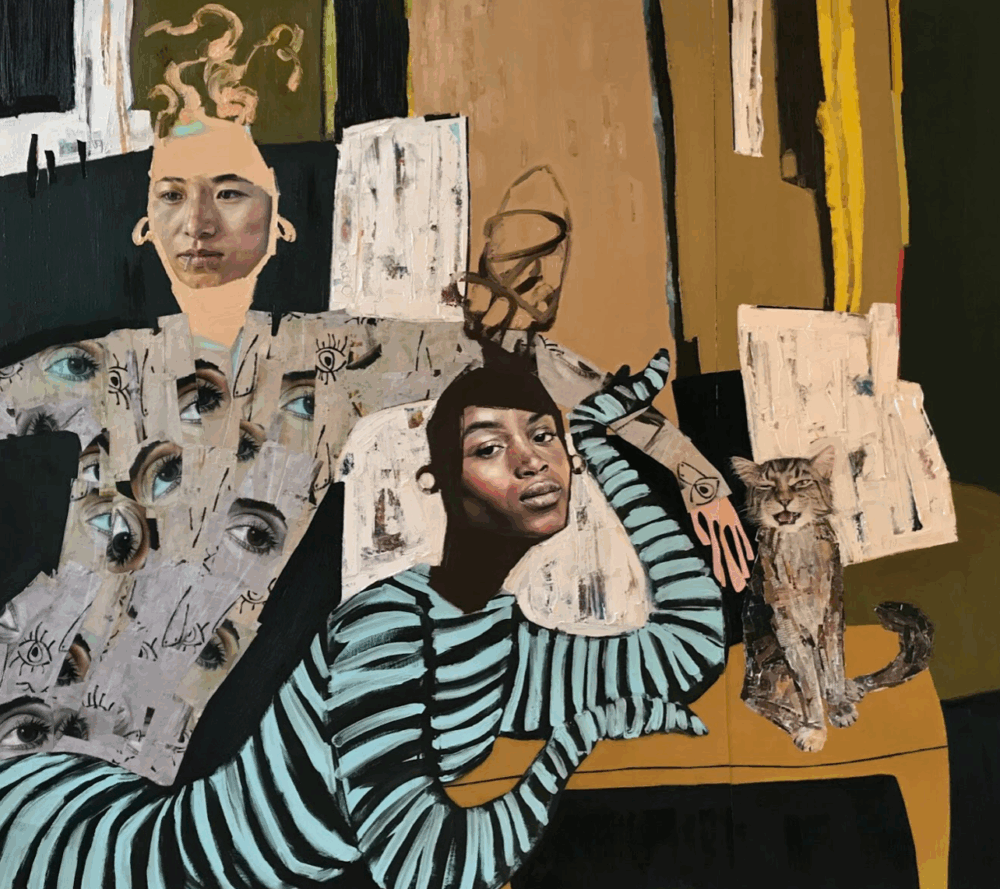
Despite the emotional weight of her subjects, Howard’s work is never one-note. Abstract marks, unexpected animals, and whimsical props frequently appear as visual counterpoints. “A bit of toil, mixed with flashes of joy — that’s life,” she says. “And I like my paintings to reflect that.”
Whether it’s a mouse perched beside a stern face or a pop of bright yellow against a moody backdrop, these flourishes offer relief — and nuance. “I don’t think my work would feel as complete without that contrast.”
Colour as Mood
Howard treats her colour palette as a psychological tool. “It’s almost as important as the content of the painting,” she says. “I’ve gone through phases — from vibrant fuchsias and electric blues to heavier tones like aubergine and burgundy. Right now, I’m somewhere in between.”
These colours often serve to either amplify or soften the emotion of the subject. “If the expression is particularly severe, I might bring in a lighter palette or humorous element to balance it out.”

Process and Practice
Howard’s process is intuitive but grounded in structure. “I usually begin with the face — often sourced from old books, magazines, or photographs and build the rest of the piece around that,” she explains. “The expression often dictates the palette and mood. A dour face might inspire a playful touch, like a cat smoking a cigarette.”
Her daily studio routine is consistent, if not rigid. “Some days it’s about painting, other days it’s about sitting with the work and waiting for it to tell me what it needs.”
Across Borders, Across Interpretations
Exhibiting internationally has revealed fascinating cultural differences in how her work is received. “The American and Australian markets tend to appreciate bolder, more distinctive aesthetics. The UK is broader in taste, and often quite open to traditional and experimental work alike,” she notes.
But wherever the audience, one thing remains constant: she resists dictating meaning. “I paint ultimately for myself,” she says. “The meaning is personal — and private. If someone finds their own story in it, that’s wonderful. But what they see in it is none of my business.”
Art Without Spectacle
In a time when contemporary art can often reward spectacle and provocation, Howard remains rooted in quiet intensity. “I like to think I make good art,” she says simply. “True, skilful art doesn’t need to shout. The rest eventually fades.”
LOUISE HOWARD: PAINTING THE SPACE BETWEEN REALISM AND EMOTION
What’s Next?
Howard is currently preparing for a private show at London’s Ministry of Sound Members Club. “This new series will be lighter and more playful,” she says. “There’ll still be women, but more animals too — a softer, funnier tone overall.”
Still, don’t expect any major pivots in meaning or message. For Howard, the real evolution lies in the process — slow, emotional, and entirely her own.