Palais Beit Al Noor: A Lebanese Story Told Through Moroccan Craft
Created from an 18th-century medersa and three interconnected courtyard houses, Palais Beit Al Noor is one of Marrakech’s most personal new stays: a 12-room residence shaped by displacement, family memory and the rituals of home.
The plainest doors in Marrakech often conceal the most remarkable places. Pass through one and the noise of the medina falls away, replaced by shaded courtyards, cool stone, the quiet movement of water and sunlight filtering through carved plaster. Behind the door of Palais Beit Al Noor lies something more personal: the memory of a family home that no longer exists.
Set in Zaouia Abbassia, a quieter, less-travelled quarter of Marrakech’s historic medina, this intimate 12-room residence brings together an 18th-century medersa, a traditional Berber house and a smaller douheria arranged across three connected patios. Its name means “House of Light”, but the story behind it begins in the shadow of war.
Palais Beit Al Noor was created by Franco-Lebanese couple Nicolas and Joëlle Delsuc. Working with Lebanese interior designer Mia Derbas of Dubai-based UMA Interiors and a team of Moroccan master craftspeople, they spent almost two years restoring the collection of historic buildings. The intention was never simply to open another beautiful riad. They wanted to recreate the feeling of a home that Nicolas knew only through stories.
The house his grandmother remembered
Nicolas grew up listening to his grandmother, his teita, describe her family home in Tyre, on Lebanon’s Mediterranean coast. It was a house with open doors, enormous tables and rooms filled with neighbours, relatives, food and music. People came and went without ceremony. Hospitality was instinctive rather than performed.
When Nicolas eventually travelled to Lebanon to find the house for himself, he discovered it had been destroyed during the country’s long years of conflict. The physical building had disappeared, but the memory of it continued to exert a powerful pull. Palais Beit Al Noor grew from that absence.
The project was initially imagined for Lebanon, where Nicolas and Joëlle hoped to begin the next chapter of their lives. But the country’s instability made the plan increasingly difficult. Then, on 4 August 2020, Joëlle was injured in the explosion at the Port of Beirut. The blast devastated large areas of the city and killed more than 200 people. For Joëlle, returning to Beirut was no longer only a question of practicality or security. It carried the weight of physical trauma. Marrakech offered another possibility.
In its courtyard houses, food culture and long traditions of craft, the couple recognised something familiar. There was the same importance placed on gathering, on generosity and on the home as a social space. The cultures were distinct, but the emotional rhythm felt connected.
A Moroccan house with a Lebanese breath
Palais Beit Al Noor does not attempt to recreate Lebanon in Morocco. Its architecture, materials and craftsmanship remain firmly rooted in Marrakech.
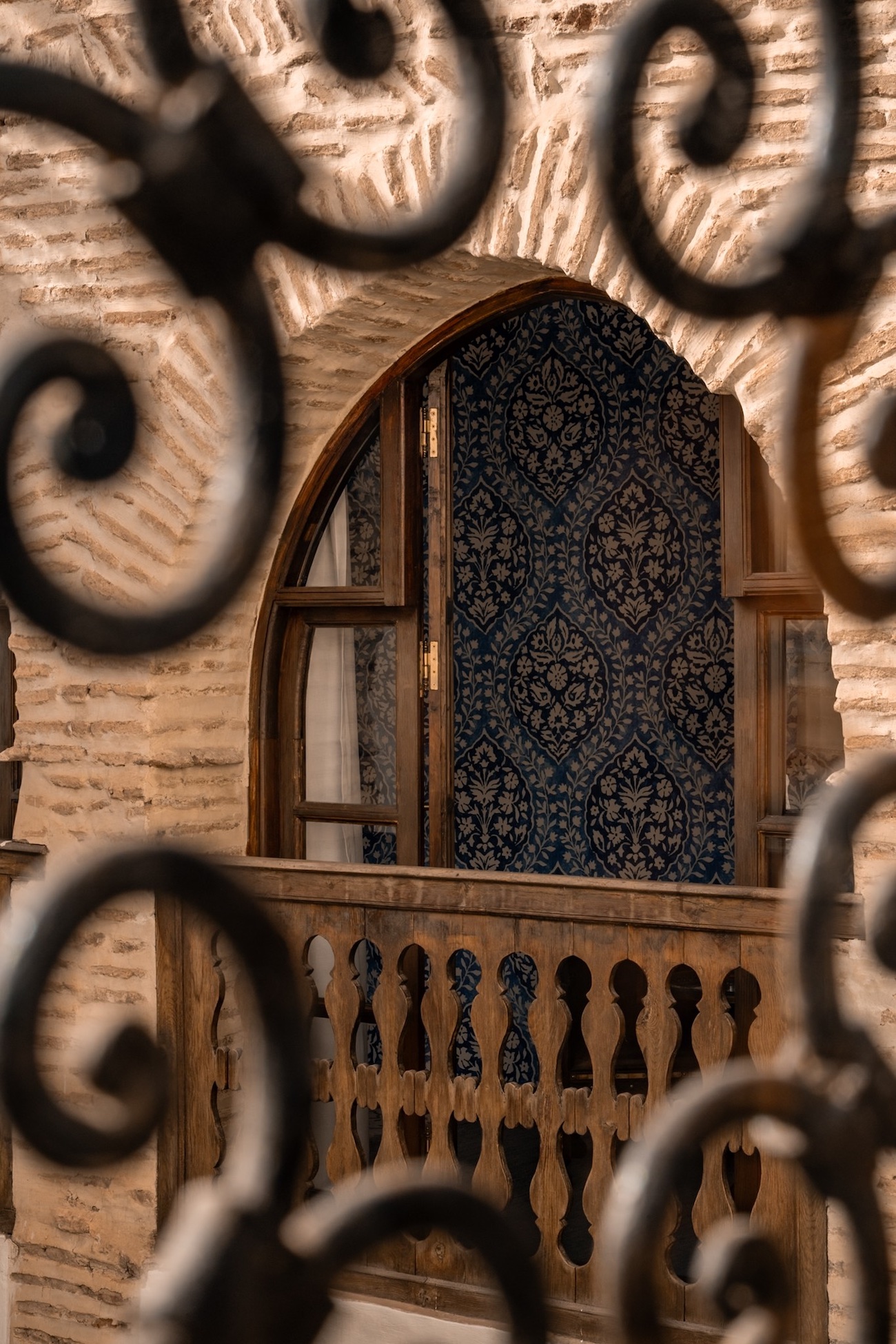
The owners describe the Lebanese presence more subtly, as a “Lebanese breath” running through the palace. It can be found in a wrought-iron detail, the shape of an arch or a patterned cement tile inspired by the floors of old Beirut homes. It appears in flashes of colour, crystal lighting and the fleur-de-lis motifs once common in Lebanese interiors.
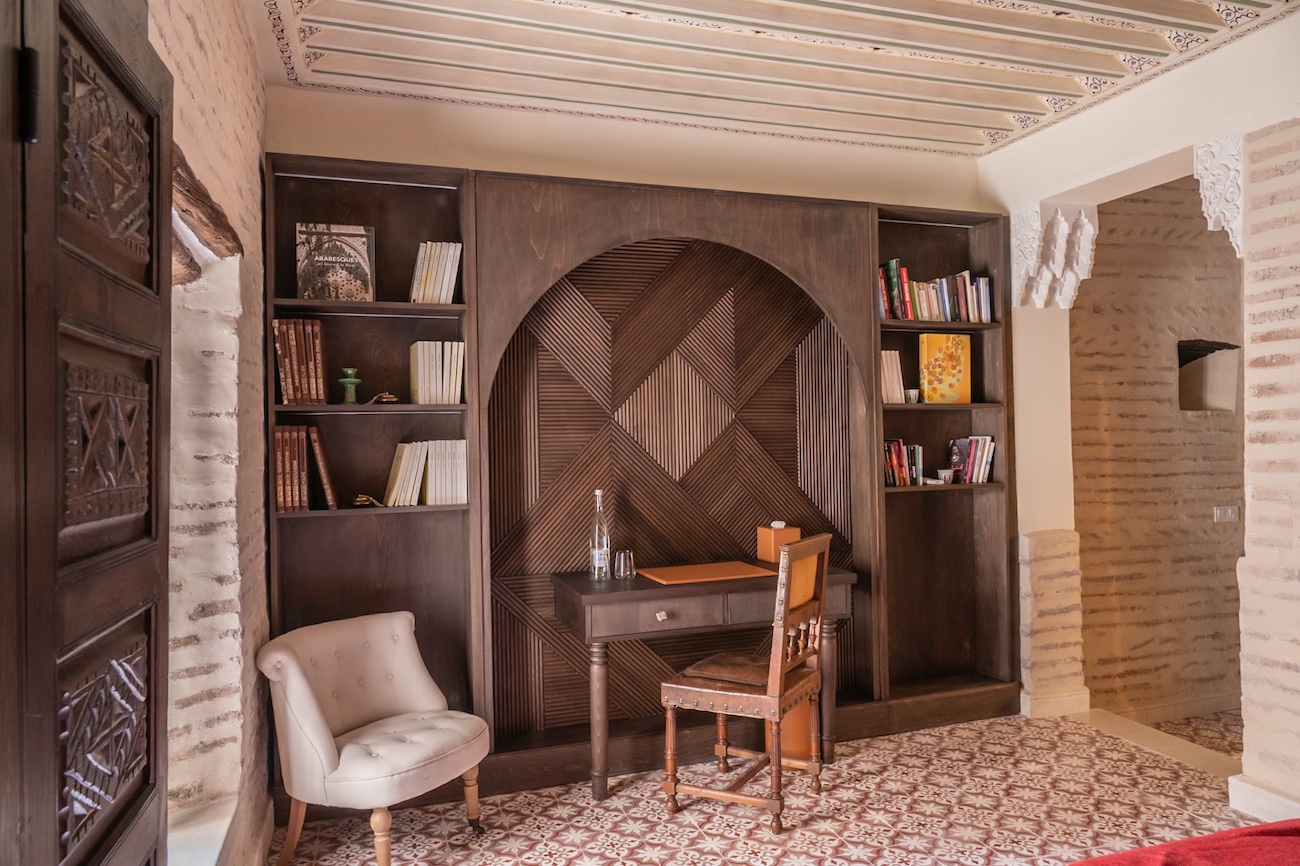
Most importantly, it appears in the atmosphere the couple wanted to create: less a formal hotel than a house in which guests are welcomed personally, fed generously and encouraged to stay a while. The effect rests on the skill of the Moroccan artisans who restored the property. Satin-like tadelakt covers the walls, while hand-cut zellige, carved cedar, intricate gebs plasterwork and painted zouak ceilings provide the palace with its visual richness.
These are not decorative gestures applied to a finished shell. They are part of the building itself, created slowly by specialist plasterers, woodcarvers, tile makers, painters and metalworkers. The result is detailed without becoming showy. Patterns and colours emerge gradually as the light moves across the patios. Surfaces carry the slight irregularities of the hand rather than the sterile precision of mass manufacture.
Three historic houses, three courtyards
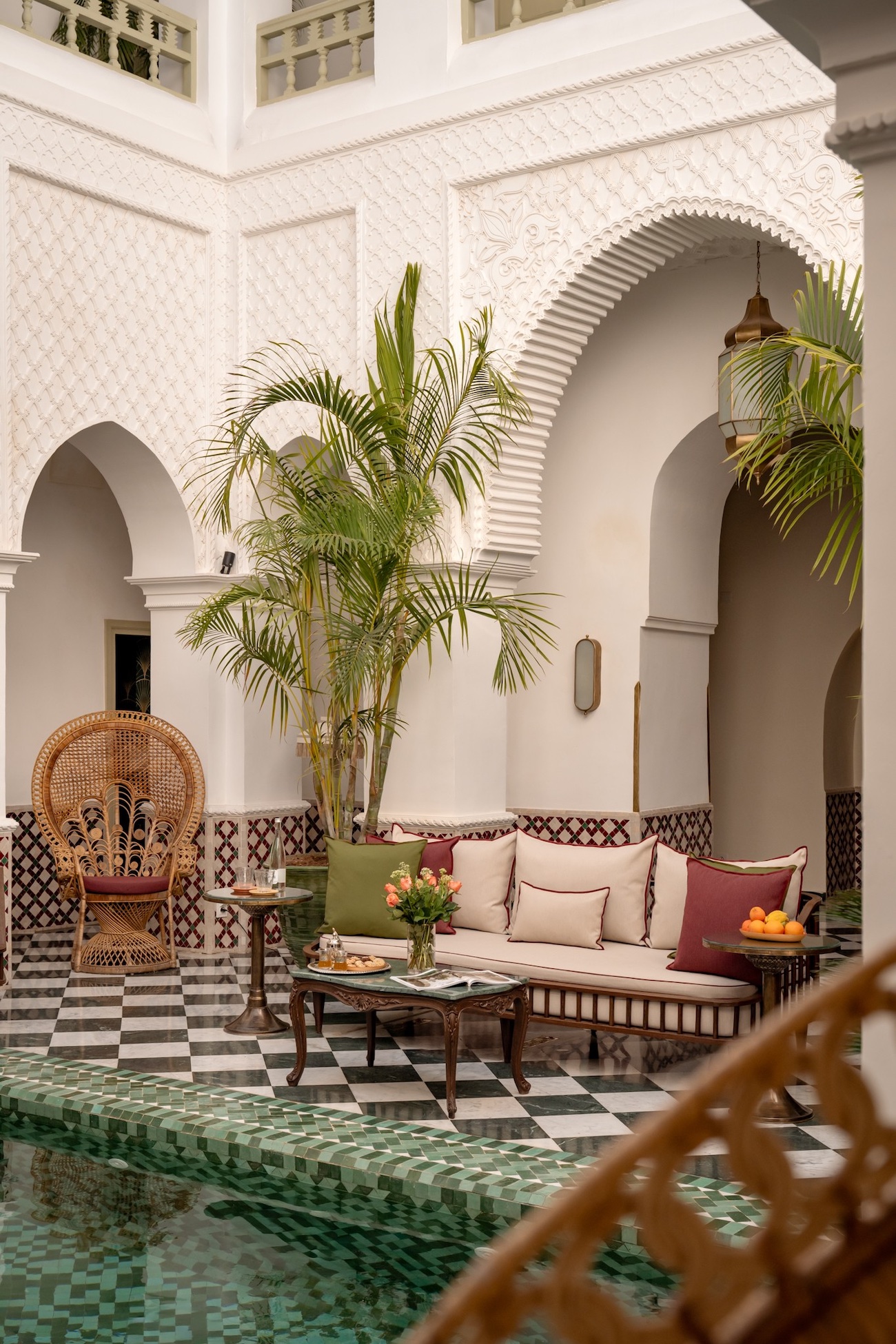
The palace unfolds around three patios, each with a different character. The Medersa courtyard is the most formal, with symmetrical arches, detailed plasterwork and a long pool lined in deep green zellige. Marble floors arranged in a white-and-green checkerboard pattern bring a cooler, almost graphic quality to the space.
The Berber courtyard feels earthier and less polished, planted with orange trees around a stone fountain. The Douheria—the name refers to a small house—offers a quieter sanctuary centred on an olive tree. Together, they create a sequence of spaces rather than one grand architectural reveal. Guests move between sunlight and shadow, enclosed rooms and open sky. That sense of progression continues upwards to two rooftop terraces overlooking the medina. Here the palace becomes more relaxed, with breakfast, tea and dinner served above the tightly packed roofs of the old city.
The rooftop restaurant is reserved for hotel guests, reinforcing the feeling of eating in a private home. Its menu brings together Moroccan produce and cooking traditions with gentle Lebanese influences: tagines, couscous and pastilla sit alongside mezze, grilled dishes, salads and homemade sweets. Arrivals are greeted with pastries and Lebanese lemonade. It is a small gesture, but one that says more about the intended style of hospitality than any conventional check-in ritual.
Rooms dedicated to Lebanon’s cultural voices
Palais Beit Al Noor has eight rooms and four suites, ranging from intimate bedrooms to the 67-square-metre Fairuz Suite with its own terrace. Each bears the name of a Lebanese artist, musician, writer or cultural figure. It is here that the relationship between memory and music becomes most apparent.
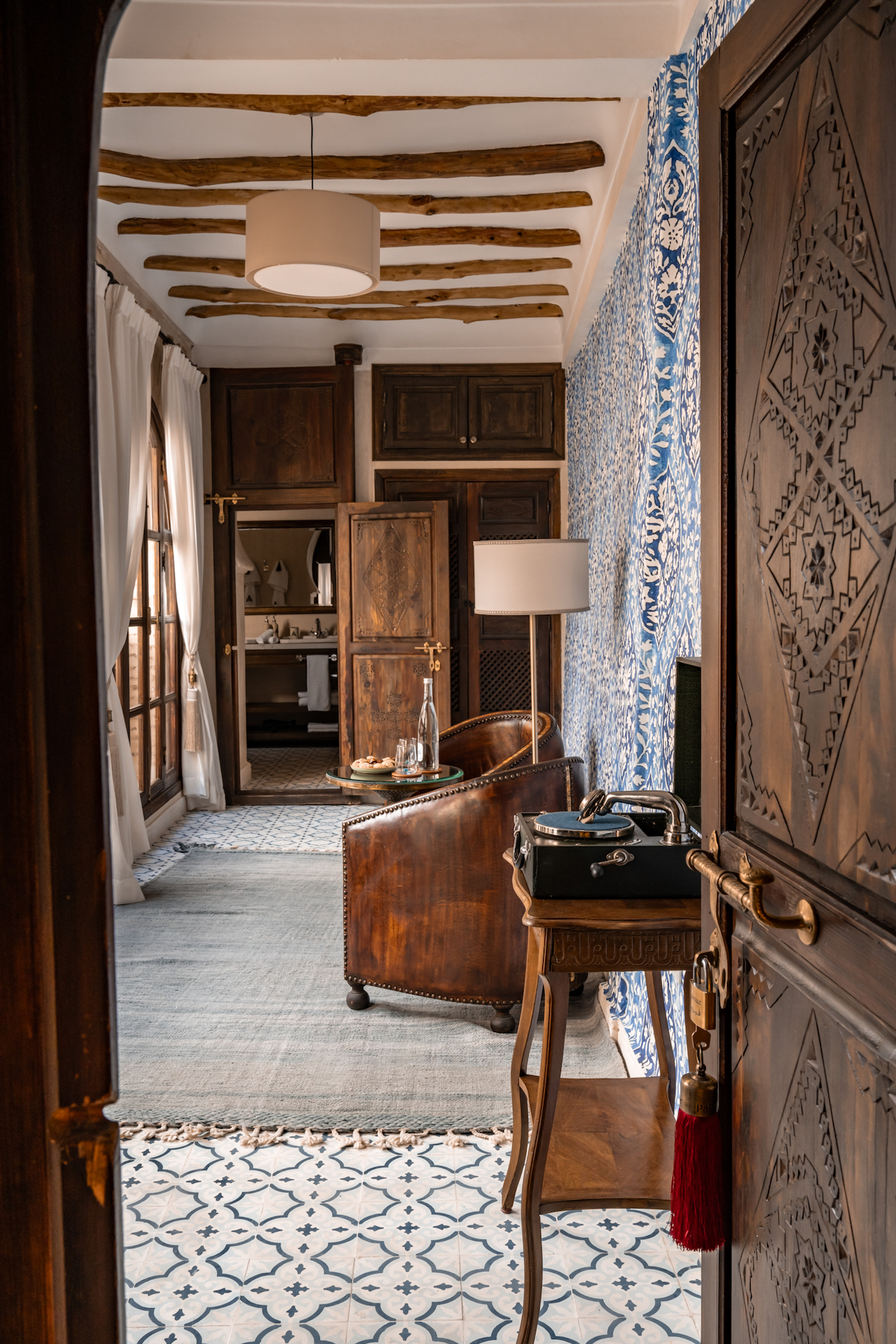
Fairuz, whose voice has soundtracked mornings across Lebanon and the wider Arab world for generations, lends her name to a blue-toned suite with a private terrace and wall of roses. The room feels less like a themed tribute than an attempt to capture something of the singer’s quiet emotional presence. The Khalil Gibran Room honours the Lebanese-American writer and artist with deep green tones, literary references and a vintage typewriter placed on the desk. Elsewhere, rooms are named after poet Said Akl and composer Assi Rahbani.
The references are intimate rather than instructional. Guests do not need to know every name to appreciate the spaces, but collectively they form a cultural map of the Lebanon the owners wanted to carry with them. Across the rooms, Moroccan techniques and Lebanese details meet without either being reduced to decoration. Naturally pigmented cement tiles recall Beirut’s historic houses, while zellige, carved plaster and woven Berber rugs anchor the interiors in Morocco.
A different kind of Marrakech luxury
Marrakech has no shortage of extraordinary hotels. Its most celebrated addresses tend to fall into two camps: monumental palaces of almost theatrical splendour and tightly designed riads created for a new generation of aesthetically literate travellers.
Palais Beit Al Noor belongs to neither entirely. It has the craftsmanship and layered interiors expected of a luxury Marrakech stay, but its strongest quality is its intimacy. With only 12 rooms and a restaurant exclusively for residents, it feels removed from the constant procession of a larger hotel.
Even its location works in its favour. Zaouia Abbassia sits within the medina but beyond its most crowded tourist routes, offering a quieter experience of the old city. The palace also has the unusual advantage of direct car access to its door—something that becomes considerably more appealing after a late flight or when travelling with several suitcases. There are no vast spa complexes or attention-seeking rooftop pools. The luxury is slower: breakfast beneath open sky, the smell of cedar and jasmine, shade beside the water and the knowledge that almost everything around you has passed through somebody’s hands.
Building a home from memory
The story of Palais Beit Al Noor could easily have slipped into sentimentality. Instead, the emotional narrative gives the design greater depth. This is not simply a palace decorated with Moroccan craft and Lebanese references. It is a house shaped by the complicated experience of belonging to somewhere that has become difficult to return to.
Nicolas and Joëlle built the feeling of a lost Lebanese home in a city they had never expected to call their own. Through architecture, food, music and hospitality, they created a form of return without pretending that one place could replace another.
Now the story has shifted again. As Palais Beit Al Noor begins welcoming guests, the couple have decided to make their home in Lebanon once more, despite the country’s continuing tensions. It brings the project full circle. Marrakech gave them the space to hold onto an idea of home when returning seemed impossible. The result is neither wholly Moroccan nor Lebanese in spirit, but a conversation between the two—a house formed by movement, memory and the people who helped make it real. Perhaps that is why Beit Al Noor feels more resonant than the average luxury hotel. It was never conceived solely as somewhere to stay. It was an attempt to rebuild a feeling.
Palais Beit Al Noor
Medina, Zaouia Abbassia
Rue Sidi Ghanem, Marrakech, Morocco
The palace has eight rooms and four suites arranged across three patios. Rooms currently start from approximately €300–€350 per night, depending on season and room category.
For further information, visit the Palais Beit Al Noor website.