PETER HOOK: MANCHESTER, MEMORY AND MUSIC THAT TRAVELS
Peter Hook on Joy Division, Manchester and Music’s Global Legacy
There are cities that export industry, and there are cities that export atmosphere. Manchester, in the late 1970s, did both. Steel grey skies, boarded warehouses, unemployment lines, and from that came a sound so distinctive it now travels farther than most airlines.At the centre of that story stands Peter Hook, bassist, memoirist, reluctant myth and increasingly, cultural custodian. A man as likely to be picking up his wife or taking the dog out as discussing post-punk immortality. The domestic detail matters. It dismantles caricature. Legends, after all, still have normal things to do.
What endures about Joy Division is not simply the music, but the migration of the music. Travel anywhere, Seoul, São Paulo, Stockholm, and the Unknown Pleasures waveform appears on T-shirts that were never officially made. The iconography escaped its creators decades ago. The image became global before global culture was even a phrase. And yet, as Hook has often reflected, none of it was strategy.
The Accidental Architecture of Sound
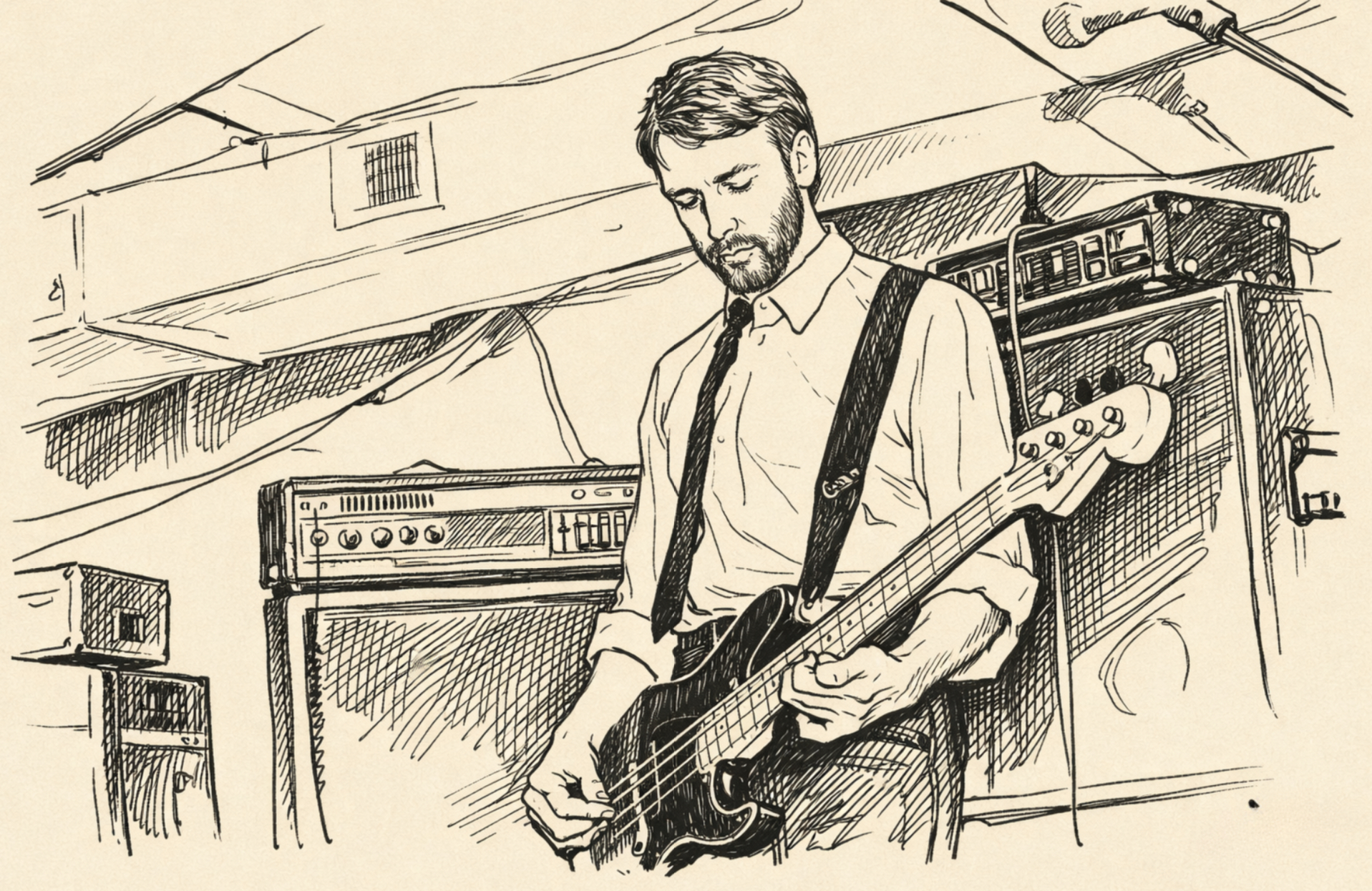
The signature Hook bass line, melodic, high, cutting through the mix, was not born from theory but necessity. Bernard Sumner’s amplifier was so loud in rehearsal that the only way Hook could hear himself was to move higher up the neck. Constraint became style. Accident became identity.In freezing rehearsal rooms on Manchester’s industrial fringes, nobody was plotting cultural immortality. Nobody was drafting manifestos about minimalism or modernism. They were simply trying to make something that felt urgent and real.Hook is clear about it. You do not sit in a cold warehouse thinking this will still be played in forty years. You write because you have to. Longevity is something other people decide.
Even the early independence of Factory Records was less romantic rebellion than practical survival. On Factory, modest sales could sustain a band. On a major label, compromise would have been compulsory. That autonomy allowed the music to develop without dilution and allowed Manchester’s cultural confidence to crystallise into something exportable.
From that ecosystem emerged The Hacienda, not simply a nightclub but an experiment. Architecture, sound and attitude collided under one roof. Its concrete floors may now be residential foundations, but its blueprint still shapes nightlife from Berlin to Ibiza.Manchester was the catalyst. The world became the amplifier.
Why Joy Division Still Resonates Globally
Hook has long been fascinated by the fact that the band’s appeal stretches far beyond geography. Fans who have never visited England, who have never experienced the economic climate that shaped the music, feel an intense connection to it “It wasn’t by design,” he has said. “The music just lasted.”That chemistry between four people, spontaneous and uncalculated, produced something strangely borderless. You do not need to understand Salford to feel Atmosphere. You do not need to know Moss Side to absorb Digital. Emotion translates without subtitles.
Hook once described how great music perpetuates itself. Someone plays a record to a friend because they think they will appreciate it. That act, intimate, personal and unbranded, is how culture travels. Not through marketing. Through belief.Even the mythology surrounding Ian Curtis often overshadows the simplicity of how the band operated. There were no grand conversations about image or stagecraft. Curtis did not choreograph his intensity. It emerged. They did not debate sleeve theory. They chose what felt right. In hindsight it looks conceptual. At the time it was instinct. And instinct travels.
Performing the Past Without Living in It
When Hook began performing Joy Division albums in full with The Light, there were predictable accusations. Revivalism. Exploitation. Sentimentality. He half expected a crowd of ageing loyalists. Instead, he found teenagers singing every word. “The music lives on,” he admitted, almost surprised.There is something quietly radical about playing an album in sequence in the age of algorithmic shuffle. It restores architecture. It restores narrative. It respects intention.Hook has been portrayed on screen more than once, most notably in 24 Hour Party People and Anton Corbijn’s Control. The former he treats with humour. The latter, he has admitted, still affects him. Cinema reframes memory. Performance reclaims it. He is not interested in embalming history. He is interested in keeping it alive.
The Haçienda, Memory and Cultural Stewardship
Anniversaries have a habit of turning living culture into museum exhibits. Each milestone, whether fortieth, forty-fifth or fiftieth, prompts retrospectives and reconstructions. But The Haçienda has never sat comfortably behind glass.When landmark anniversaries have been marked, there have been exhibitions and facsimiles. Hook preferred something less ceremonial and more visceral. Music back on the original site. Sound reclaiming space, even temporarily. “You’ve got to mark it,” he once shrugged. “You might not be around for the next one.”It is a sentiment that encapsulates his relationship with history. No reverence without rhythm. No nostalgia without noise. The Haçienda no longer exists as a building. It exists as blueprint. A template for independence, for nightlife, for creative audacity. Its influence stretches from Berlin warehouses to Bangkok rooftops. It is no longer Manchester’s alone. It is global.
Manchester as Cultural Blueprint
In an era where creative cities brand themselves into uniformity, Manchester’s story remains instructive. It was not built on gloss. It was built on friction, class tension, economic strain and DIY ambition. Culture was not curated. It was carved out of necessity. For Fused, this is the essence of creative travel.To travel creatively is not to collect landmarks. It is to understand how sound, architecture and identity shape a place and how those ideas migrate outward. Manchester’s grey skies produced a sonic aesthetic that now belongs to the world. Just as Detroit shaped techno and Berlin reframed it, just as Tokyo absorbs and reinterprets Western subcultures, cultural ideas move, mutate and return. Joy Division is no longer a local story. It is a case study in how atmosphere becomes export.
Peter Hook stands at the centre of that movement, bass slung low, humour intact, myth reluctantly accepted, not as a curator of nostalgia but as a guardian of continuity. The rehearsal room was cold. The ambition was modest. The impact was global. And that, more than anything, is why Manchester still matters, and why, through Hook’s steady custodianship, the past continues to travel.