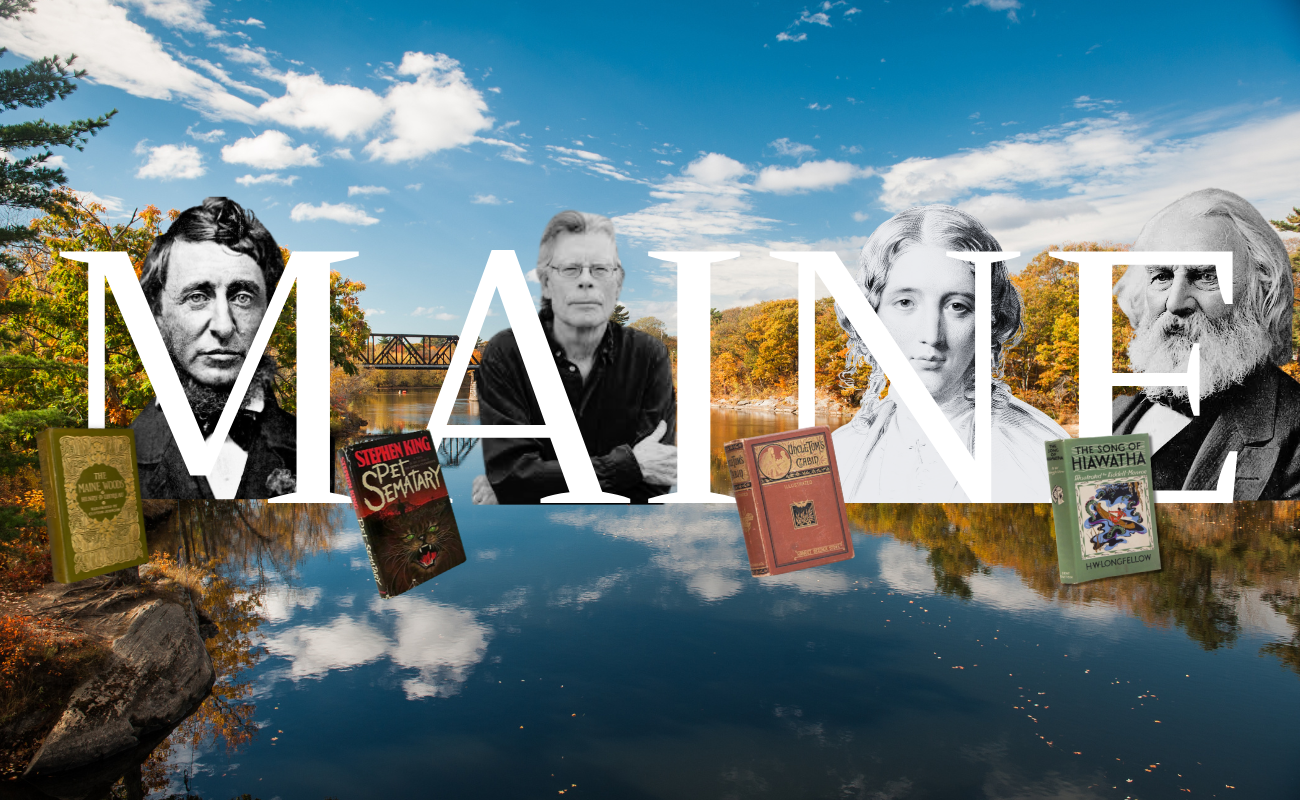
MAINE LITERARY ROAD TRIP: LONGFELLOW, STOWE, THOREAU AND STEPHEN KING
From Portland’s Wadsworth-Longfellow House to the streets that became Stephen King’s fictional Derry, a journey through Maine reveals how writers have repeatedly drawn on the state’s homes, waterways, forests and towns.
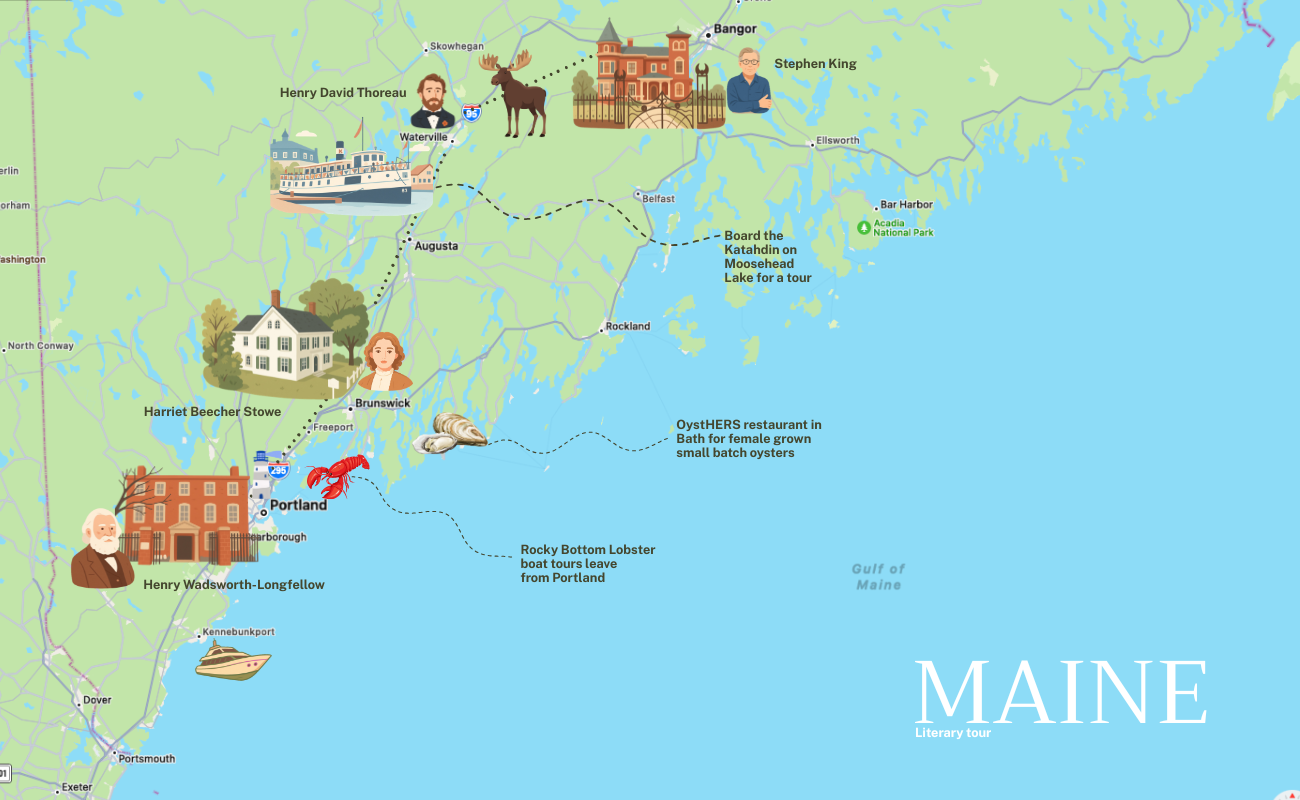
Across the state, writing and landscape continually overlap. Henry Wadsworth Longfellow grew up in Portland. Harriet Beecher Stowe wrote Uncle Tom’s Cabin while living in Brunswick. Henry David Thoreau travelled through the waterways and forests of the Maine wilderness, while Stephen King has spent decades transforming the streets, houses and cemeteries of his home state into an alternative geography populated by monsters, outsiders and unsettling small towns.
Travelling from the coast towards Maine’s interior, those connections begin to form a route of their own. Houses become entry points into political and literary history. Lakes and forests provide a different understanding of the writers who moved through them. By the time you reach Bangor, an apparently ordinary street corner can suddenly belong to two places at once: the real Maine and King’s fictional Derry.
Portland: beginning with Longfellow
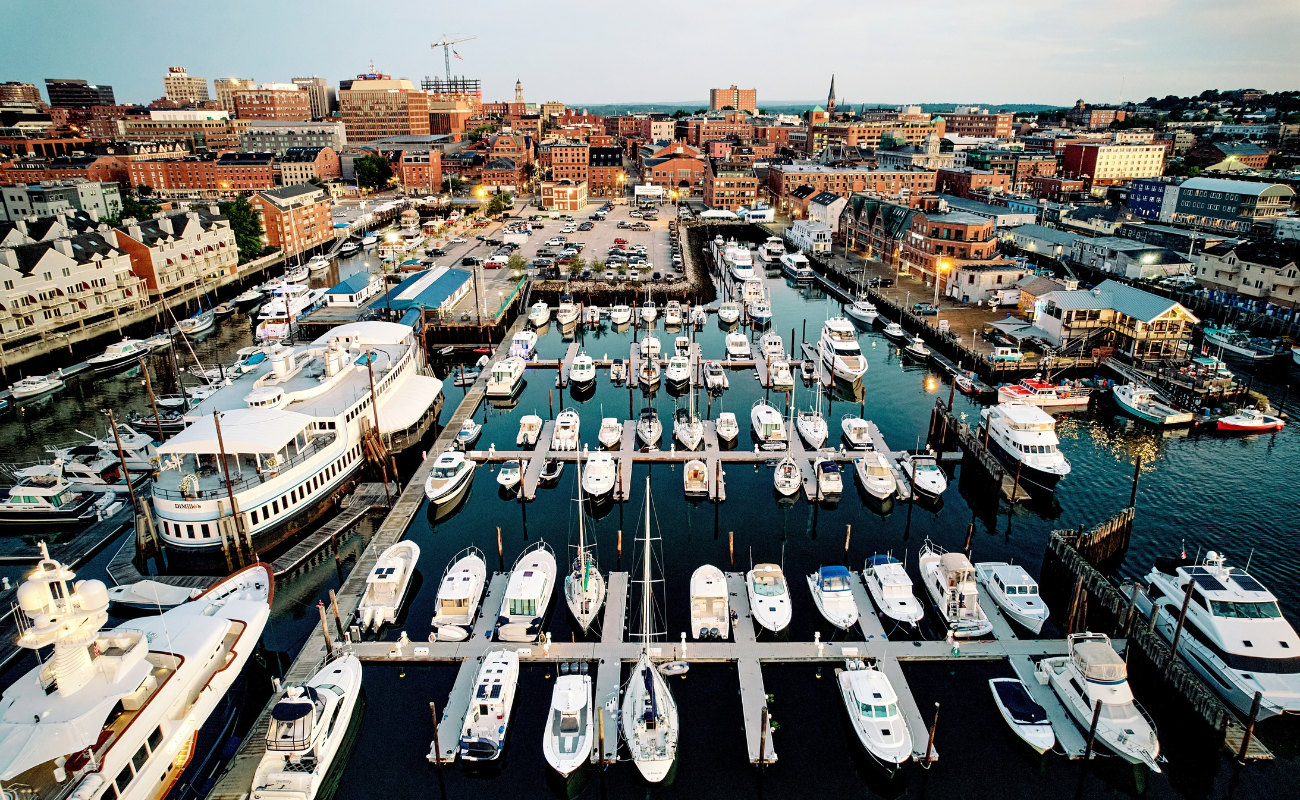
The journey starts in Portland, Maine’s largest city, where red-brick buildings, a working waterfront and bustling cafes line streets leading down towards Casco Bay, providing the setting for one of the state’s most significant literary houses.
At 489 Congress Street, the Wadsworth-Longfellow House (entrance $16) is the oldest standing brick structure on the Portland peninsula. Now cared for by the Maine Historical Society, the house was restored in 2002 to reflect its mid-19th-century character and remains one of the clearest physical links to poet Henry Wadsworth Longfellow.
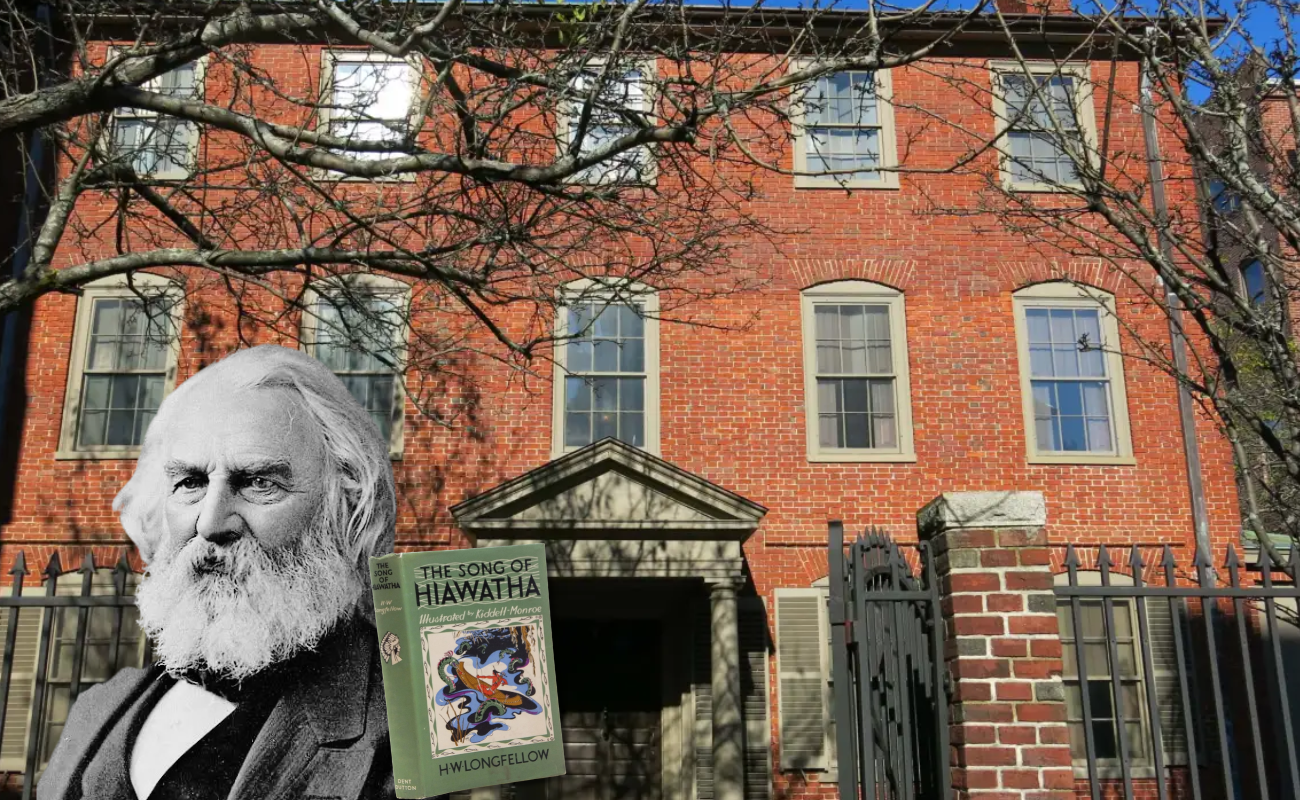
It is easy to think of historic homes as containers for biography, but here the knowledgeable guides bring Longfellow’s life and work into sharper focus, revealing the everyday routines, relationships and domestic world that once existed within these walls.
We stayed nearby at The Longfellow Hotel on Congress Street, an independent hotel in Portland’s West End. The name provides an almost too-neat beginning to a literary road trip, although the hotel itself belongs firmly to contemporary Portland rather than the poet’s world.
While in Portland: We took to the water with Rocky Bottom on an interactive lobster boat trip ($60 per person), hauling and setting traps while travelling past the city’s coastal landmarks and the Portland Head lighthouse of Cape Elizabeth. Maine’s relationship with the sea is impossible to separate from its wider identity, and moving directly from Longfellow’s domestic Portland to its working waters offers visitors a sense of the broader literary landscape. The experience was enhanced thanks to a lobster rolls on the go from nearby Luke’s Lobster on Portland Pier.
Brunswick: Harriet Beecher Stowe and writing with consequence
From Portland, the journey continues north to Brunswick. Here, the Harriet Beecher Stowe House brings literature into much closer contact with American political and social history.
Stowe lived in Brunswick from 1850 to 1852 while her husband was teaching at Bowdoin College, and it was during this period that she wrote Uncle Tom’s Cabin. The anti-slavery novel follows the lives of enslaved people, including the title character Tom, exposing the violence of slavery and the devastating separation of families. It first reached readers not as a book, but in weekly instalments in the Washington-based anti-slavery newspaper The National Era, where it ran from June 1851 until April 1852 before appearing in book form in 1852.
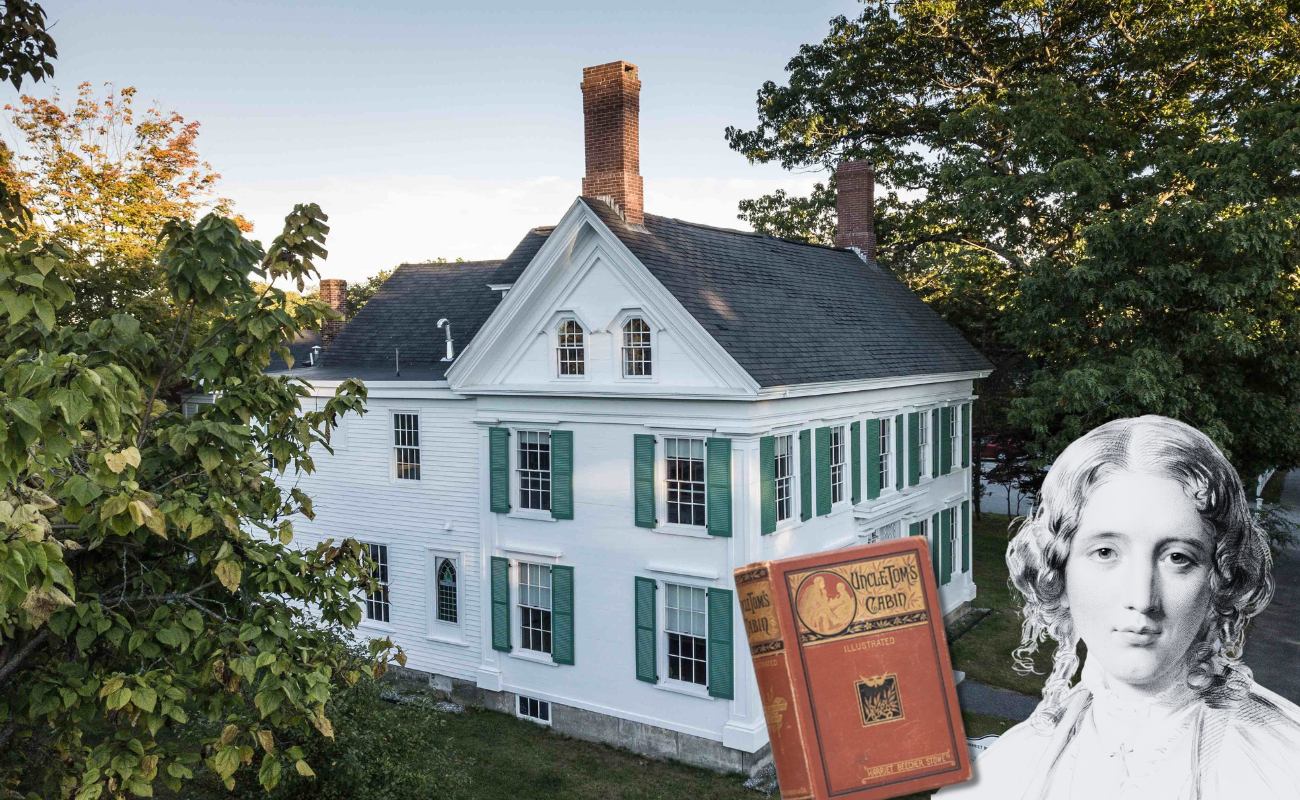
The house was also where Stowe sheltered John Andrew Jackson, a fugitive slave from South Carolina. Today the building is a National Historic Landmark and a National Underground Railroad Network to Freedom site.
Meeting Cathi Belcher and visiting Harriet’s Writing Room gave the story a more immediate scale. Rather than approaching Uncle Tom’s Cabin simply as an enormously influential book, the house encourages you to think about the circumstances in which it was written and the people moving through Stowe’s life at the time.
That makes Brunswick an important shift in the journey. Longfellow’s house is strongly connected to childhood, family and literary formation. Stowe’s becomes a place where writing, politics and lived experience intersect.
While in Brunswick: We made a short detour to Bath for dinner at OystHERS, where a spread of platters and locally grown oysters brought the coastal landscape back into the journey, providing another reminder of how closely Maine’s culture is tied to the waters surrounding it.
Our overnight stop was The Federal in Brunswick, a reimagined 19th-century home and inn that now operates as a contemporary boutique hotel.
Into the Maine woods
Leaving Brunswick for Greenville means exchanging the coast for one of Maine’s defining inland landscapes. Greenville sits on Moosehead Lake, the state’s largest lake, surrounded by forest, mountains, rivers and huge expanses of water.
It is here that the literary route opens out from houses and streets into landscape. We boarded the Katahdin Steamboat for a cruise across Moosehead Lake with Suzanne AuClaire, President of the Thoreau-Wabanaki Trail Festival, travelling past Sugar Island and other landmarks while hearing more about the region.
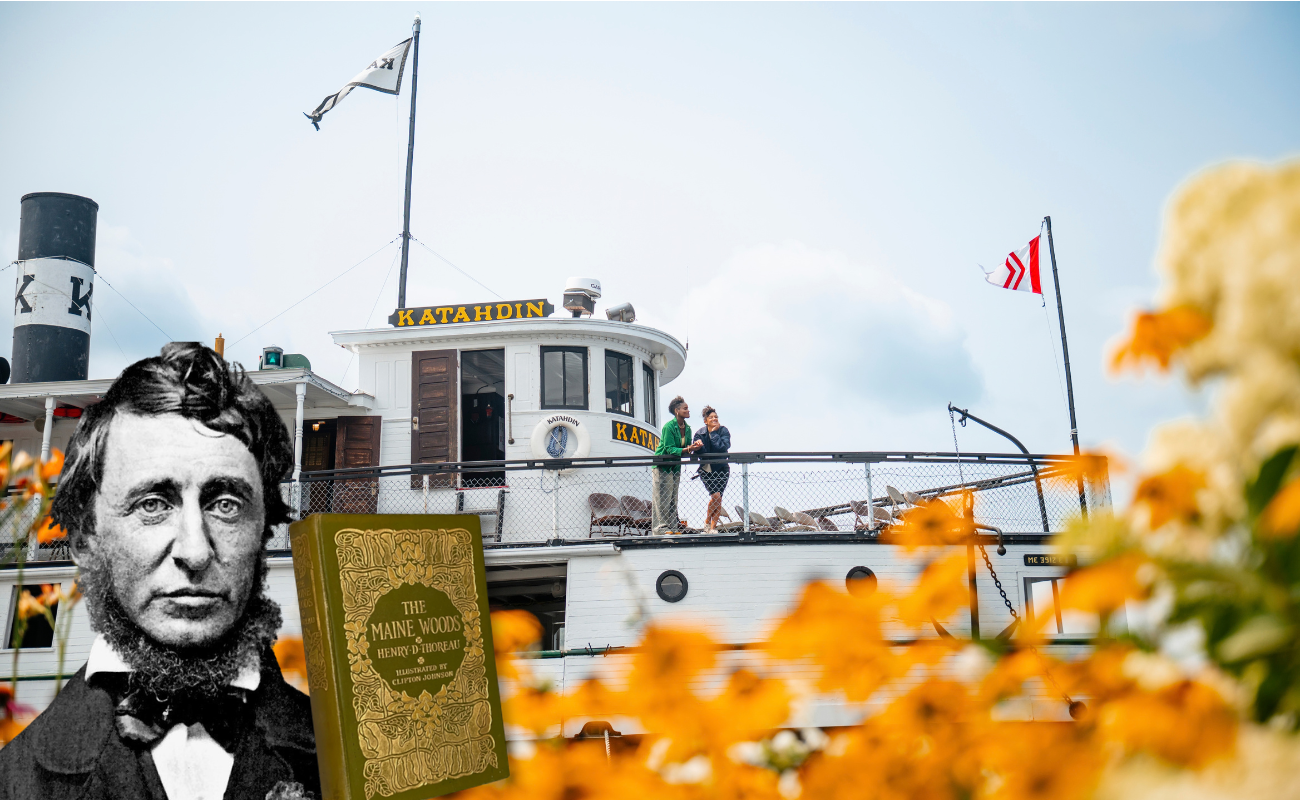
The scenery alone explains part of Maine’s enduring pull on writers. Forest appears to extend almost indefinitely beyond the water, with human settlement becoming a much smaller part of the picture.
Henry David Thoreau, the 19th-century American writer and naturalist whose journeys through Maine informed The Maine Woods, is closely associated with this landscape. But considering those travels today also means looking beyond the familiar image of the solitary writer disappearing into the wilderness.
The Thoreau-Wabanaki connection brings Indigenous knowledge and long-established routes back into the story, recognising that these waterways and forests were understood and navigated long before Thoreau arrived. His close attention to the natural world can feel remarkably contemporary, but his understanding of this landscape was also shaped by people whose knowledge of it ran far deeper than that of an outside visitor.
While in Greenville: Later that afternoon we headed back into the landscape with Northeast Whitewater for a private moose tour, accompanied by our Registered Maine Guide, Sam. The moose proved a little shy on our visit, but deer and eagle sightings made a fine substitute, as did Sam’s running commentary on the landscape and his deep local knowledge. In the end, the experience was less about ticking wildlife off a list and more about entering the habitat of an animal that remained tantalisingly out of sight.
Sleeping among Greenville’s history
Greenville Inn provided an appropriately historic, and slightly unsettling, setting for the night. The property retains English-tiled fireplaces, quarter-sawn oak interiors and original hand-carved woodwork, while historic New England photographs, family portraits and paintings line the walls.
Arriving to find no one at reception added a faintly spooky edge, although it soon became clear that this was less ghost story and more small-town trust. Doors were left unlocked, room keys were waiting, and a well-stocked honesty bar was on hand for a nightcap.
Following a night of much-needed heavy rain, the morning arrived clear and bright. From the inn’s hilltop setting, fresh coffee and pancakes drizzled with locally made maple syrup came with a view across the tree canopy, where the first autumn colours were beginning to break through the green.
After a day spent looking at Maine through Thoreau, Wabanaki knowledge and the natural environment, the inn added another layer of local history. Rather than a generic rest point between destinations, Greenville felt part of the journey through the state’s changing character.
Stephen King’s alternative Maine
Of all the literary figures on this journey, Stephen King provides the strangest overlap between real and imaginary geography.
Before entering King’s Derry, the Orono Bog Walk offers a suitably atmospheric introduction. The mile-long wooden boardwalk runs through Bangor City Forest and into Orono, passing through northern peat bog and forested wetlands. The area is designated a National Natural Landmark, and Director Dr. Becky Van Beneden proved the ideal guide to its flora and fauna.
As a transition into Stephen King country, it could hardly be better. King’s fiction repeatedly makes use of forests, waterways, small communities and apparently unremarkable corners of Maine. Walking through an environment where dense vegetation and dark water sit just beyond the boardwalk creates an almost cinematic prelude to seeing how those landscapes are repurposed in his fictional world.
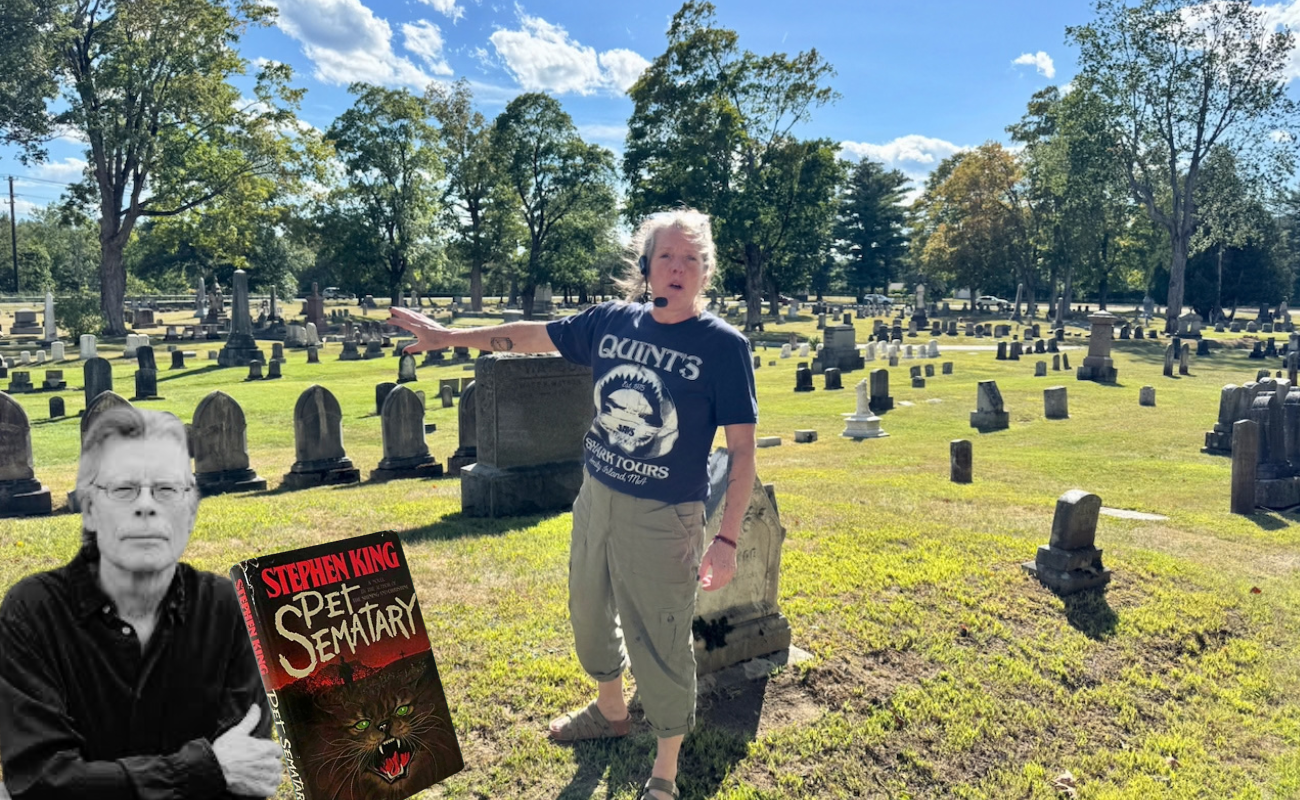
Bangor is the inspiration for Derry, the fictional Maine town that appears across King’s interconnected body of work. On an SK Tours trip through the city ($62.40 per person), places that might otherwise look like ordinary streets, houses and municipal landmarks are suddenly given another identity.
Our guide, Jennifer, took us to locations that have inspired King’s stories alongside sites connected with screen adaptations. Her knowledge feels encyclopaedic, with seemingly no King novel unread or adaptation unseen.
For anyone familiar with IT, Bangor creates a peculiar form of literary recognition. You know Derry does not exist, yet its component parts are everywhere. Certain streets, buildings and locations have been lifted from King’s surroundings and reworked until they belong to his mythology as much as to the city itself. That makes the tour less about identifying isolated filming locations and more about understanding how closely King has observed the place around him.
The cemetery stop makes that relationship particularly clear. We saw the ‘Carrie’ headstone connected with King’s inspiration as well as locations associated with the filming of Pet Sematary. Here, names, gravestones and other everyday details become part of the raw material that can move from real life into fiction and then, sometimes, onto screen. It is one of the most enjoyable aspects of exploring Bangor through King’s work. Reality and fiction continually trade places.
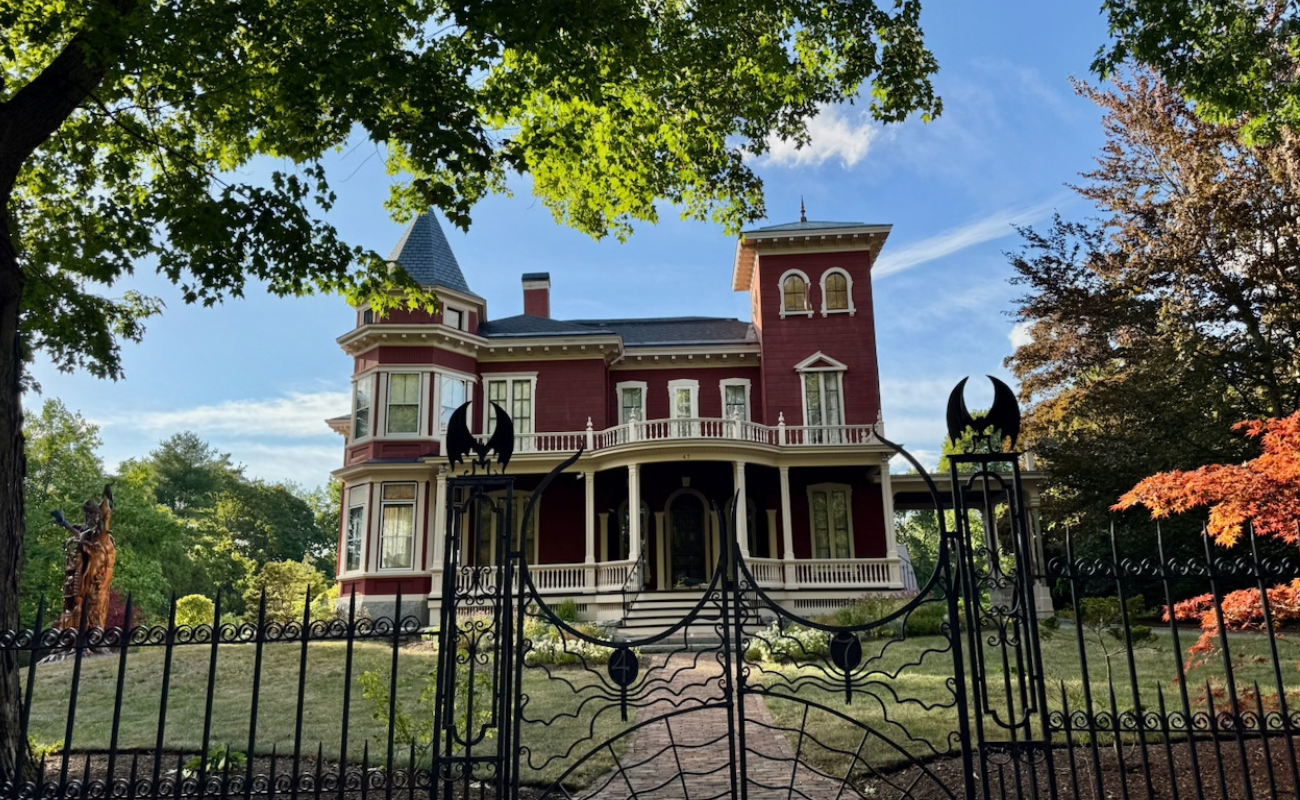
Last on the tour was King’s former home, one of Bangor’s most recognisable literary landmarks. The red Victorian mansion, complete with its suitably spooky wrought-iron gates, is now owned by the Stephen and Tabitha King Foundation with its neighbouring mansion intended to have a future life supporting writers.
Carrie at 50
The timing gives this part of the trip additional relevance. The 1976 film adaptation of Carrie reaches its 50th anniversary in 2026, bringing renewed attention to the novel that began King’s published career. It also arrives at a point when Carrie is returning to television in a new adaptation for Prime Video, introducing another generation to a story that has repeatedly been reinterpreted since its first publication.
That longevity is striking when you are travelling through the landscape behind King’s work. Fifty years after the film, Maine remains central to the way audiences imagine him. King may have created monsters, supernatural towns and extraordinary events, but the foundations frequently remain recognisable: schools, houses, cemeteries, roads, sewers, forests and small communities. The horror works precisely because so much of its geography feels ordinary.
A final night in central Maine
From Bangor we continued south to Waterville, staying at the Lockwood Hotel on Main Street. The contemporary 53-room hotel made a marked contrast with Greenville Inn’s historic interiors, moving the journey back towards a more modern interpretation of Maine hospitality.
Waterville is a stopping point rather than a major chapter in the literary itinerary, and that is perhaps the right way to treat it.
The following day we continued towards Boston, stopping in Kennebunkport for lunch and a final look at coastal Maine before leaving the state. By then, however, the landscape had become difficult to view without thinking about the writers we had followed through it.
Reading the landscape
What connects Longfellow, Stowe, Thoreau and King is not a single literary tradition. Their writing belongs to different periods, genres and ideas about America. What they share is a particularly strong relationship with place.
In Portland, that connection begins inside a family home. In Brunswick, a writing room opens onto the political realities surrounding Stowe’s work. Around Moosehead Lake, the walls disappear, and literature becomes inseparable from waterways, forests and Indigenous knowledge of the land. By Bangor, the process has reversed. Instead of travelling through a landscape described by a writer, you begin travelling through a landscape that has been dismantled and reconstructed as fiction.
Perhaps that is what makes Maine such an interesting literary destination. You are never simply visiting the places where writers lived, but you get to move through the material they wrote with.
Words: Kerry O’Coy
For more information and places to visit see Visit Maine.
Fused flew to Boston with Aer Lingus you can find flight prices and schedules here.