This summer, Manchester-based artist Katie Tomlinson (b. 1996, Tees Valley) presents a solo exhibition with Brooke Benington Gallery at Amici in Hastings, Sussex. Titled Bathers Bathing, the exhibition explores representations of the female nude from the history of art, filtered through contemporary queer and femme perspectives and beyond. For Fused Magazine, Matt Price went to see the show and find out more from the artist about cispatriarchy, pyromania and whether liberating the image of women from the past might be a leap from frying pan to fire…
FUSED: Katie, congratulations on this wonderful solo exhibition. Can you talk me around the show?
KT: So the exhibition is called Bathers Bathing. It takes various different bathers from art history that I’ve selected for different reasons – often because they look a bit bored or a bit uncertain or displaced, maybe. So there are bathers taken from fourteenth–century Spain through to a little etching from the 1920s. I’ve appropriated them then changed them – lots of them have changed quite dramatically. I’m not really bothered if they don’t look like the original, as long as there’s a suggestion of them.
FUSED: They’re resources, starting points.
KT: Exactly, but the starting point is really important. I’m interested in the idea that they are all bathers that were once fixed within another image made long ago, whether of real or imagined women. All of them are women apart from a couple of characters, who were labelled as men but were made to look really feminine. It was a manual from the fifteenth century called The Art of Swimming, to teach people how to swim because a lot of people were drowning. The men were made to look really effeminate because the author wanted them to appear weak and unlikely to be able to save themselves without the advice proffered in the manual. So I quite liked that… it makes perfect sense for my practice and interests. I like that there was an element of gender subversion there.
FUSED: Can you tell us more about this? What are you looking to achieve when you transplant these figures into your paintings?
KT: In my paintings I want to speak about femininity and about my experiences as a woman. I want to explore the things that are placed on you because of your gender. As with the group exhibition Queer Painting: Intervals I’ve co-curated with my partner Chester [Tenneson] downstairs, I’m interested in queer experience and gendered narratives, gendered histories, gendered stories, stereotypes.
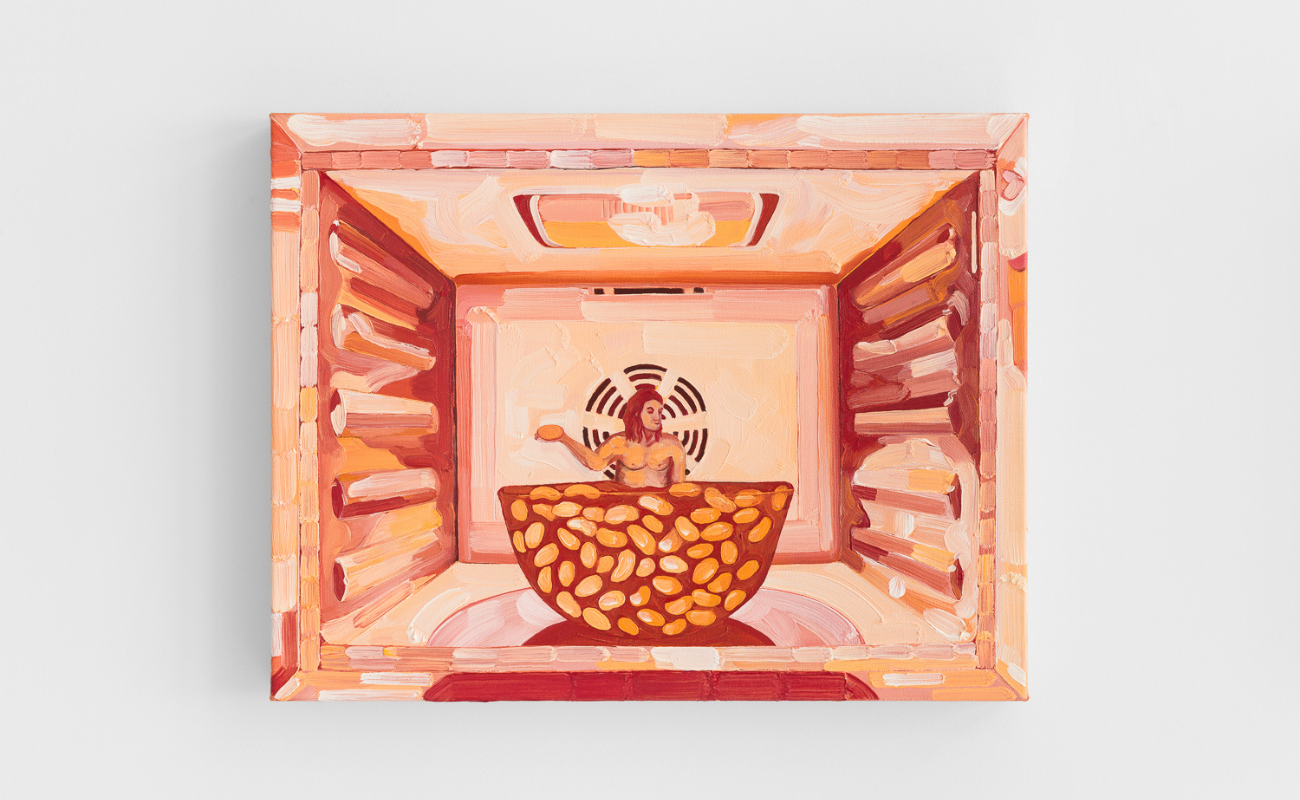
Katie Tomlinson – Rude Imitation, 2026, oil on panel. 20 x 25cm.
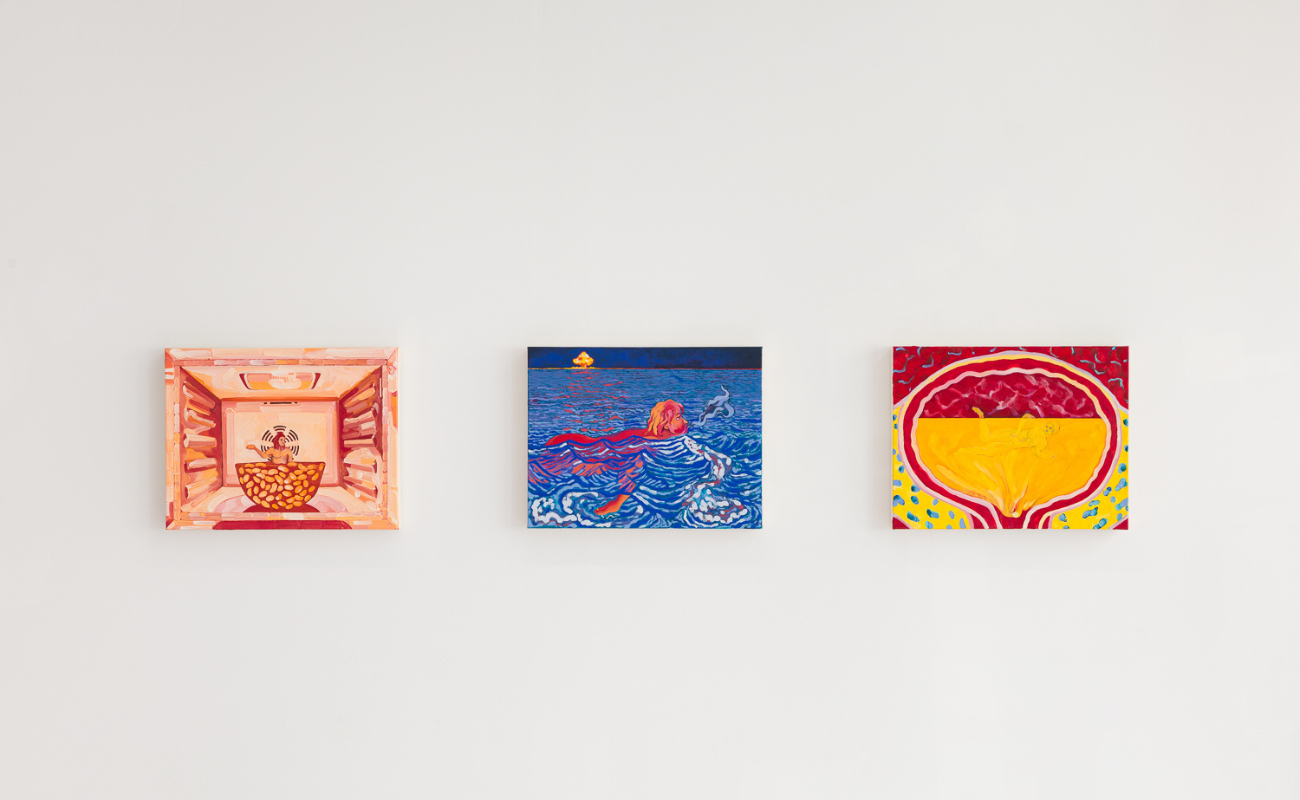
FUSED: Some of the works are quite surreal. You recently had a major work acquired for Manchester Art Gallery’s permanent collection via the Manchester Contemporary Art Fund [The Best Things in Life Are Free, 2023] – a scene in which couples dancing together intimately are presented as if staged inside an oven, like a theatre set for a ballet or an opera – and here you’ve taken us back inside the oven, well, inside a microwave oven, in Rude Imitation [2026].
KT: And it’s the exact size of the microwave in my studio. This was very important to me for some reason. Some things have to be a certain way in my paintings, and then other things can be more fluid. What I choose to keep from the sources is important for me and other things just don’t have the same resonance.
FUSED: In this painting, you have a bowl of baked beans inside the microwave oven, presumably either before, during or post heating. But inside the bowl of beans a figure is depicted bathing, like some kind of sponsored charity challenge by the Borrowers.
KT: Ha! Yes, I’ve used another figure from the swimming manual in this painting. I liked the idea of the figure just carrying on bathing, regardless of the context. She’s a bather, so all she can do is bathe.
FUSED: What you keep from the source and what you change or introduce is clearly a decision process that’s essential to this body of work.
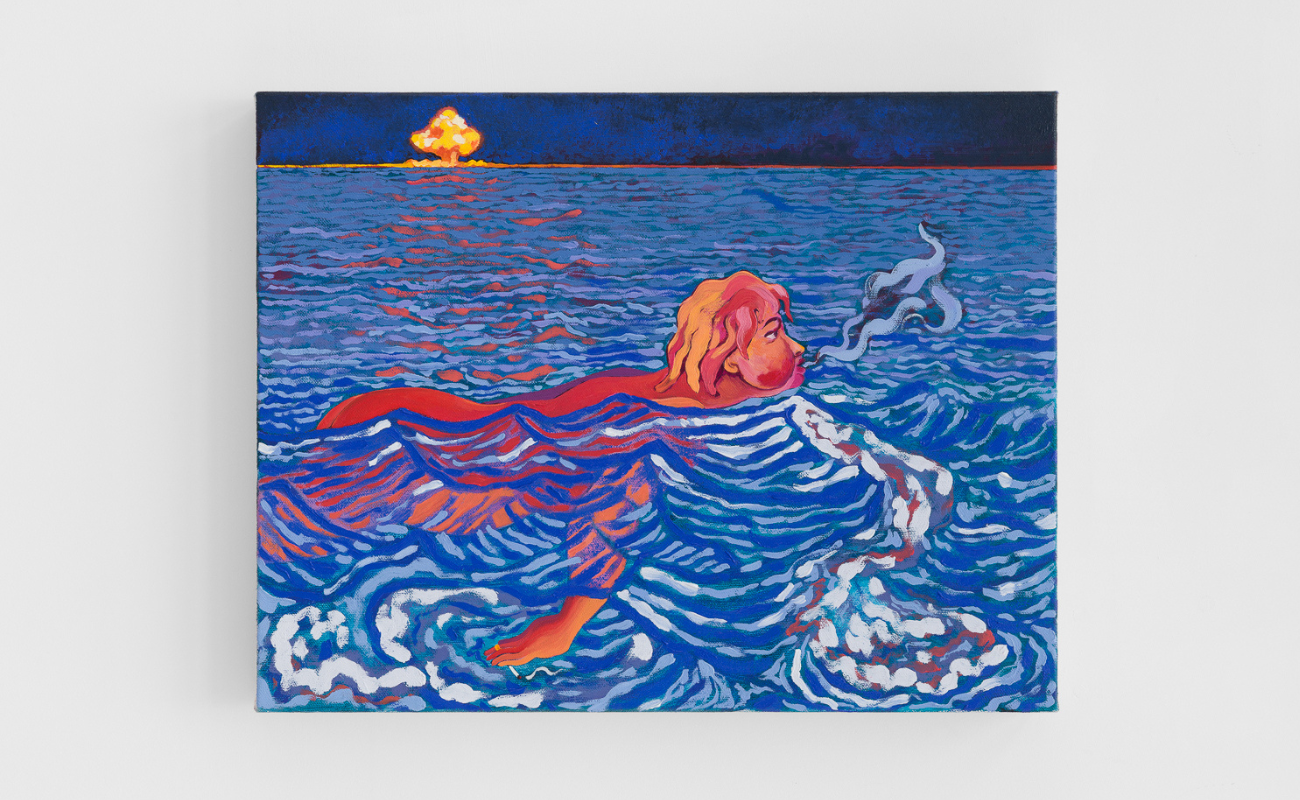
Katie Tomlinson – A Famous Stroke, 2026, oil on panel. 35 x 45 cm.
KT: Yes, for example, it was important for this painting [A Famous Stroke, 2026] to retain the original drawing’s huge cheek puffing, but then I enjoyed adding the cigarette and making the ‘rainbow’ hand among other things. The scene itself is mostly imagined, including the nuclear explosion in the background. I am particularly interested in juxtapositions between the mundane and the apocalyptic in this series of works.
FUSED: I’m sure somebody somewhere has been swimming when a nuclear bomb has been tested nearby – on the Mururoa Atoll or something – with or without a cigarette. So, you’re keen to recontextualise these bathers from art history in all different kinds of imagined contexts.
KT: Yeah, they’re all in these different states of bathing. Some of them in ponds, lakes, rivers, even in a bladder…
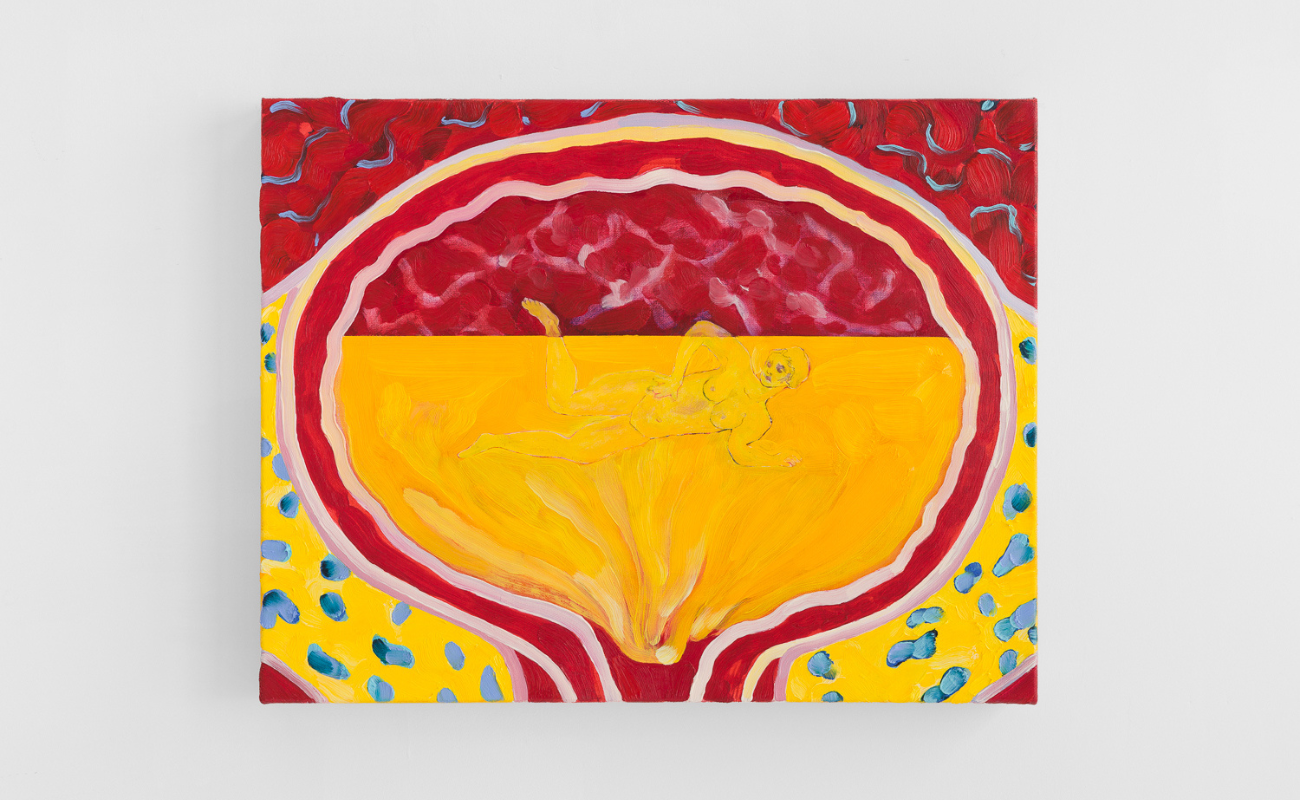
Katie Tomlinson – Staying Afloat, 2026, oil on panel. 35 x 45cm.
FUSED: Oh wow, this a bladder [Staying Afloat, 2026]? I’d assumed it was a womb, full of amniotic fluid.
KT: Yes, it’s from a diagram of a bladder. And I was drawn to the diagram because I thought it looked like an abstract painting. I felt there was something really painterly about it. It was a diagram about these little fatty bits of tissue surrounding a bladder. And obviously, they’re not that colour – in the diagram they were a blue colour.
FUSED: It’s like a curious ode to Howard Hodgkin or Clyde Hopkins…
KT: Yeah, I wanted to make something in a colourful, decorative, more abstract way of painting. And why wouldn’t there be a bather swimming in it?
FUSED: Within the body of work there is a certain logic to it.
KT: Some of the bathers are depicted in these very claustrophobic kinds of settings; I wanted to investigate the idea of these women being contained in confined, uncomfortable and dangerous spaces. For me it’s a way of talking about the current moment politically. And I don’t just mean in the queer context, but also in the wider world context – we’re in a heightened state of anxiety and angst at the moment. You only have to turn on the news. Within all of these artworks there’s a feeling of fear or a sense of danger and uncertainty.
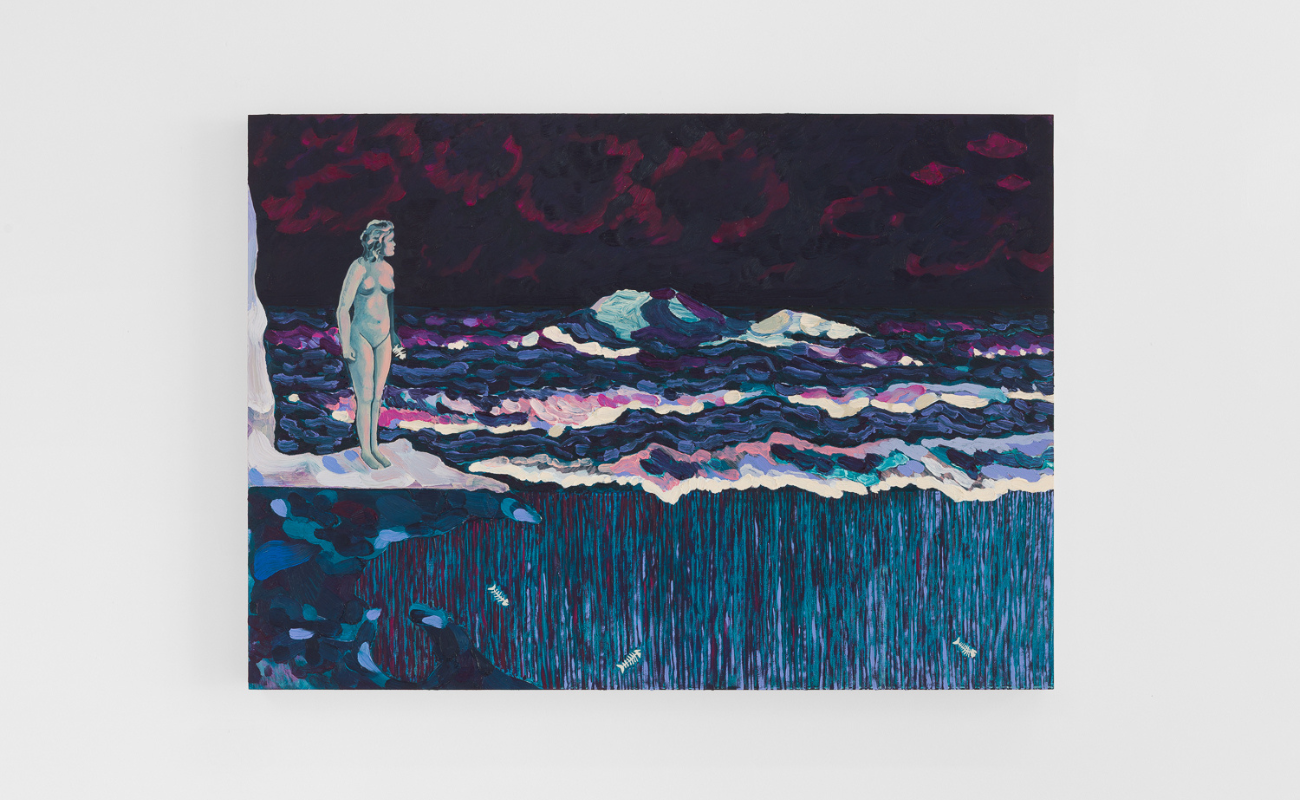
Katie Tomlinson – Deep Sea Bather, 2026, oil on panel. 50 x 70cm.
FUSED: In Deep Sea Bather [2026] a woman stands on a rock staring out into a treacherous sea beneath a menacing crimson sky.
KT: Yes, and there are some little UFOs among the clouds. These come from something Winston Churchill set up in the early 1950s – the Ministry of Defence UFO Archive. The UFOs are based on a sighting that’s in that archive, from the ’60s, in Sheffield. Soon after, the guy who took the photos said that it was a hoax but then later turned around and said it wasn’t a hoax. I thought that the story was interesting. It’s not just the history of painting that I like to appropriate, it’s also these other weird moments of fakery, foolery or mischief. I find things such as these add to the sense of mystery that I’m looking to create in my paintings.
FUSED: Would you say that you are using these approaches to question or challenge art history?
KT: Yes, and this comes back to my original point about the idea that these characters have been placed within this kind of cispatriarchal canon of art history, whether they liked it or not. We see these characters and they are very familiar to us. We know what a bather is within the context of art history because we see it in every gallery, every national museum. We see these characters and we are taught about them in school. We are very aware of the tradition of the nude woman bathing. And yes, I wanted to subvert that, challenge it, play with it. So I took existing characters, existing bathers, and I imagined them like a hundred years later, a thousand years later, or a million years later – when everyone else in the world has gone, whether we destroyed ourselves through climate collapse or some other self-inflicted end of the world scenario, or at least the end of humanity within it.
FUSED: So, in some ways, as an artist, you are taking back agency from the heteronormative depiction of women bathers in the history of art, where they have been stuck, trapped.
KT: These bathers are still existing in our consciousness because they were painted – they were painted into permanence. They were made into fixed figures, signs, and so I’ve been imagining what their futures might be. And their futures are looking pretty bleak at the moment. You’ll see that in my paintings they’re lounging, a lot of them are smoking, some of them are eating olives. This Deep Sea Bather character symbolises that we’ve eaten all of the fish from the ocean, with just a few bones tossed back in. She’s watching the end of the world unfold, and she’s unbothered by that. All of my characters seem unfazed by the devastation that’s taking hold around them. Maybe they feel powerless, don’t realise what’s happening or have just had enough and don’t care anymore. It’s a metaphor of sorts for the circulation of media, the circulation of imagery of women and how they’ve so often had their agency removed.
FUSED: Even if they’re taken out of their original confines, they’ve been put back into a context and a world that’s probably even worse than the one they were in before.
KT: Yes, exactly, and I’ve enjoyed playing with that. For the bathers, it’s like they’ve been plucked out and dropped in a different dimension. What is this world? And I think there’s something really funny about that; the world’s always changing but some things are always fixed. No matter what, women, unfortunately, as for many different people, experience prejudice. And for women, it just so happens that the gaze is inescapable – the same can be true for some men, and for queer people, for different reasons. You have these pressures put on you because of your gender. And that’s what these works are – they’re simply metaphors for what women experience every day. But they poke at the absurdities of that as well.
FUSED: There’s certainly a strong element of the absurd, and the surreal, in the exhibition. You said that the sources are really important for you. How important is it that the viewer understands those references?
KT: As long as they know that they’re bathers, that’s the main thing. They don’t need to know that one of the figures is a giant bather by Picasso, Dora Maar. They just need to know that she’s bathing in a dog bowl. So yes, really absurd, really surreal. I’m playing to the humour whilst maintaining something a little bit darker, a little bit more sinister as well.
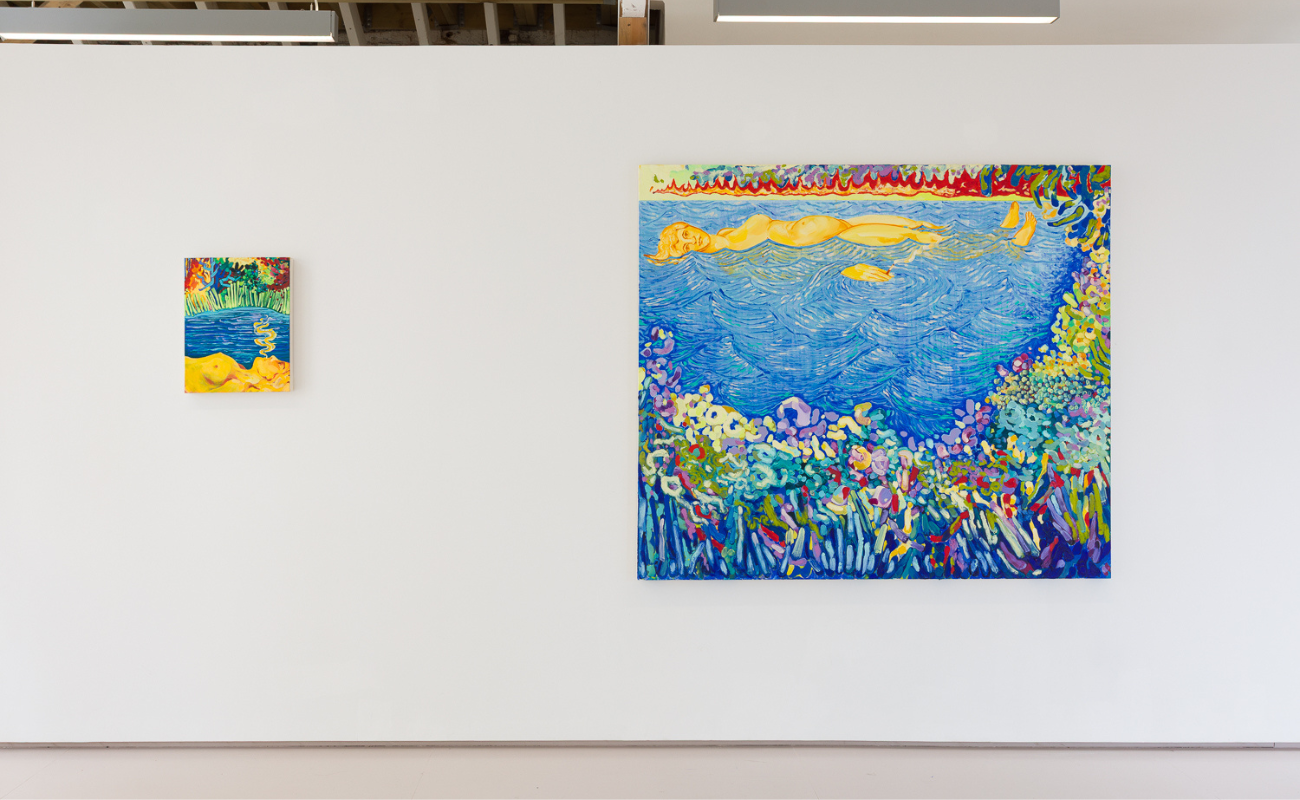
Amici Studio Katie Tomlinson Bathers Bathing
FUSED: There are some surreal locations and scenarios, but then there are some more traditional bathing scenes too, which are oddly haunting.
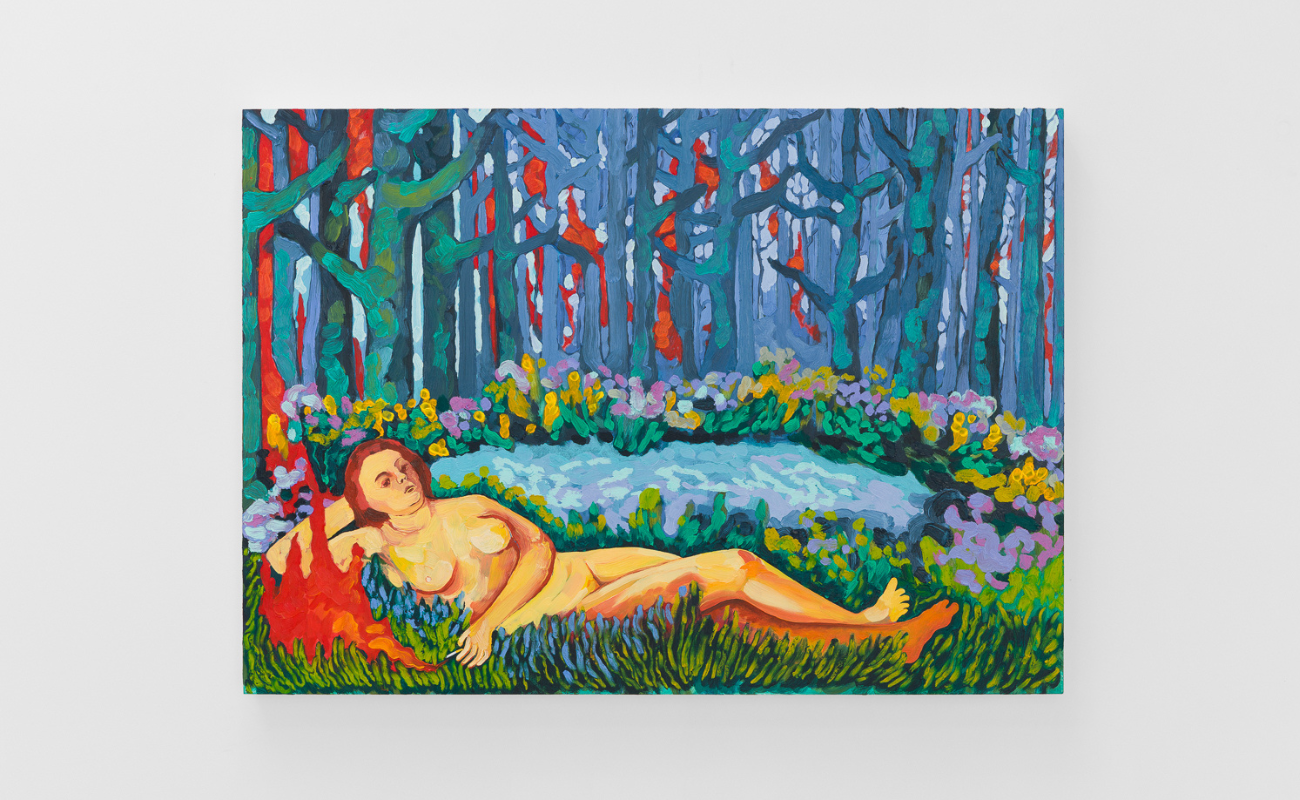
KT: The consistency of these works is the inconsistency of place. Yes, there are some paintings that are more evocative of Impressionist and post-Impressionist landscape scenes, which I really enjoy painting, and they can be quite subversive in their own way. The bathers are looking back at us through queer eyes. But then there are these other scenes that are just sort of in your face, like the baked beans in a microwave. I think this is something that I like to do; it comes naturally for me, the playfulness of that. And I think it’s something that characterises my work.
FUSED: An odd, dark humour as well.
KT: Definitely. Yeah. I think it is quite a queer strategy to do that. I think it’s quite a northern thing as well, to be honest. Chester and I recently went to Cork to give a presentation as part of Histories and Painting: Contemporary Negotiations, A Painting Symposium at the Triskel Arts Centre, and so many of the Irish students came up to us at the end – they were really excited that we were talking about humour and humour within painting specifically. We were discussing with them how little writing there seems to be on humour and painting. There certainly seemed to be a connection between northern humour and Irish humour based on our experiences. It’s a bleak form of humour, dark and bleak.
FUSED: Humour is famously hard to write about.
KT: Yes, especially comedy and art. I mean, as soon as you start writing about it, you seem to lose the thing that makes it funny. There is a show coming up at the Lowry in November [2026] in which Chester is taking part – indeed, he proposed the idea for the exhibition. As well as featuring lots of fabulous artists, there are also several comedians who happen to make art. Sheri Klein wrote a book on Art and Laughter and in it she talks about wit and how it’s not humour as in laugh out loud. It’s that kind of wit, wry humour that I’m interested in, that element of play or surprise. It’s an area that needs more research so I’m looking forward to the show at the Lowry. The Lowry’s got a really good programme now, and the curator there, Zoe Watson, is absolutely amazing. They’ve got a really good show up at the moment, called Curtains Up.
FUSED: Oh yes, there are some great painters in that show. I’ve only just spotted those fabulous small ceramic works down there. Is that something that you have been experimenting with recently?
KT: I started working with ceramics during my third year when I was at Manchester School of Art, so there’s always been that interest in clay as a material and getting my hands dirty. I’ve got a show in Zurich at the end of the year [2026] with Modern Animals Gallery, which I’m really looking forward to, and I’m thinking of making some more expansive ceramics for that. The texture of painting is something that I’m very much interested in and I enjoy the textures that working with clay offers. I’m keen to explore the relationship between the two. Hopefully this might lead to creating some kind of narrative painting within the ceramic medium. I often wonder what a particular painting would look like in ceramic, and what that might yield differently. Both clay and paint go through a physically involved process to get to the point where they become fixed. I have also been thinking about the relationship between the intense heat of firing in a kiln and depictions of intense heat, of fire, ovens and so on. Hence these ceramics pieces here depict a cigarette starting a fire – a motif that is explored in a couple of the paintings in this exhibition.
Amici Studio Katie Tomlinson Bathers Bathing
FUSED: Oh yes, I can see that in Do Not Disturb My Sleep and An Elegant Display [both 2026]. These are really key paintings in the exhibition, I feel. It’s interesting that your bathing bathers are endangering the idyllic environments they are surrounded by, whether intentionally or inadvertently. Perhaps it’s their only means of breaking free.
Katie Tomlinson – Bathers Bathing, is on show at Brooke Benington @ Amici, Hastings – the exhibition has been extended until 28th August 2026, by appointment.
A group exhibition co-curated by Katie Tomlinson and Chester Tenneson titled Queer Painting: Intervals, ran in the downstairs space from 20 June to 11 July.
Artwork photography: (C) and courtesy of the artist and Brooke Benington, Hastings
Install images courtesy of Brooke Benington, Hastings